π^3: Scalable Permutation-Equivariant Visual Geometry Learning
Yifan Wang, Jianjun Zhou, Haoyi Zhu, Wenzheng Chang, Yang Zhou, Zizun Li, Junyi Chen, Jiangmiao Pang, Chunhua Shen, Tong He
2025-07-18
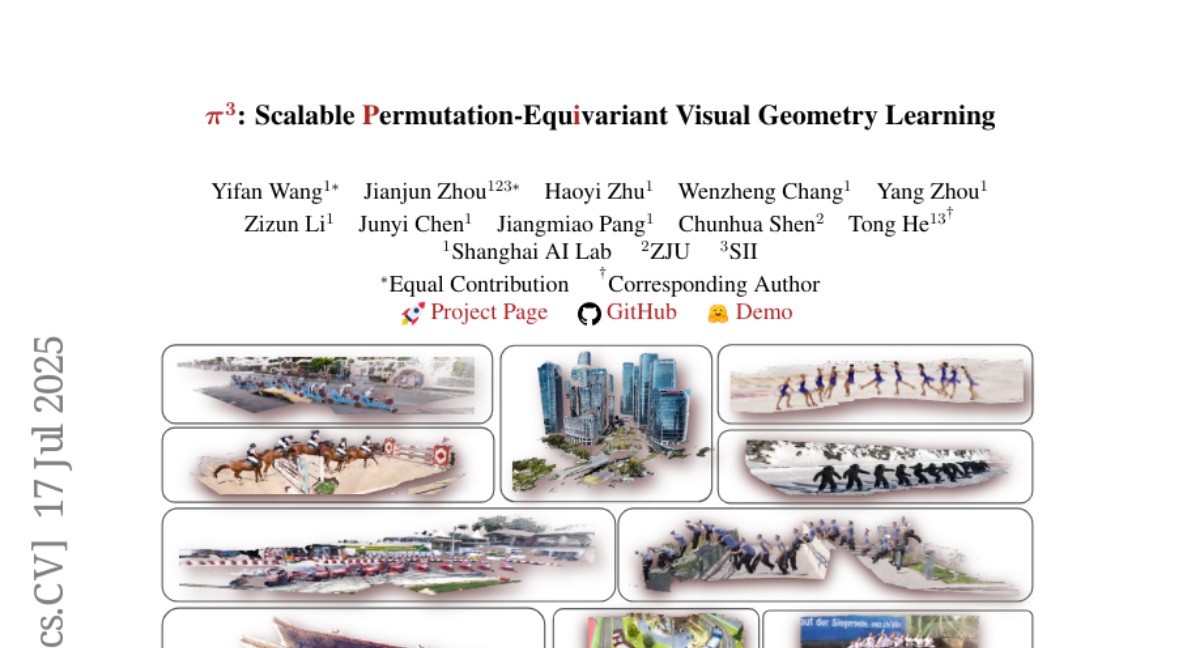
Summary
This paper talks about π^3, a special type of neural network that can understand 3D shapes and spaces without needing a fixed starting point, which helps in tasks like figuring out camera positions and creating depth maps from images.
What's the problem?
The problem is that many models struggle to recognize or rebuild 3D scenes if they rely heavily on a specific reference view, which can limit their accuracy and flexibility when dealing with visual data from different angles.
What's the solution?
The authors created a permutation-equivariant neural network, which means the model treats inputs the same way no matter their order or viewpoint. This allows it to reconstruct 3D geometry more reliably and perform really well on tasks such as estimating where a camera is located, measuring depth, and rebuilding point maps.
Why it matters?
This matters because better understanding of 3D scenes from images helps improve technologies like augmented reality, robotics, and self-driving cars by giving machines a more accurate sense of the real world around them.
Abstract
A permutation-equivariant neural network, $\pi^3$, reconstructs visual geometry without a fixed reference view, achieving state-of-the-art performance in camera pose estimation, depth estimation, and point map reconstruction.