A Data-Centric Framework for Addressing Phonetic and Prosodic Challenges in Russian Speech Generative Models
Kirill Borodin, Nikita Vasiliev, Vasiliy Kudryavtsev, Maxim Maslov, Mikhail Gorodnichev, Oleg Rogov, Grach Mkrtchian
2025-07-21
Summary
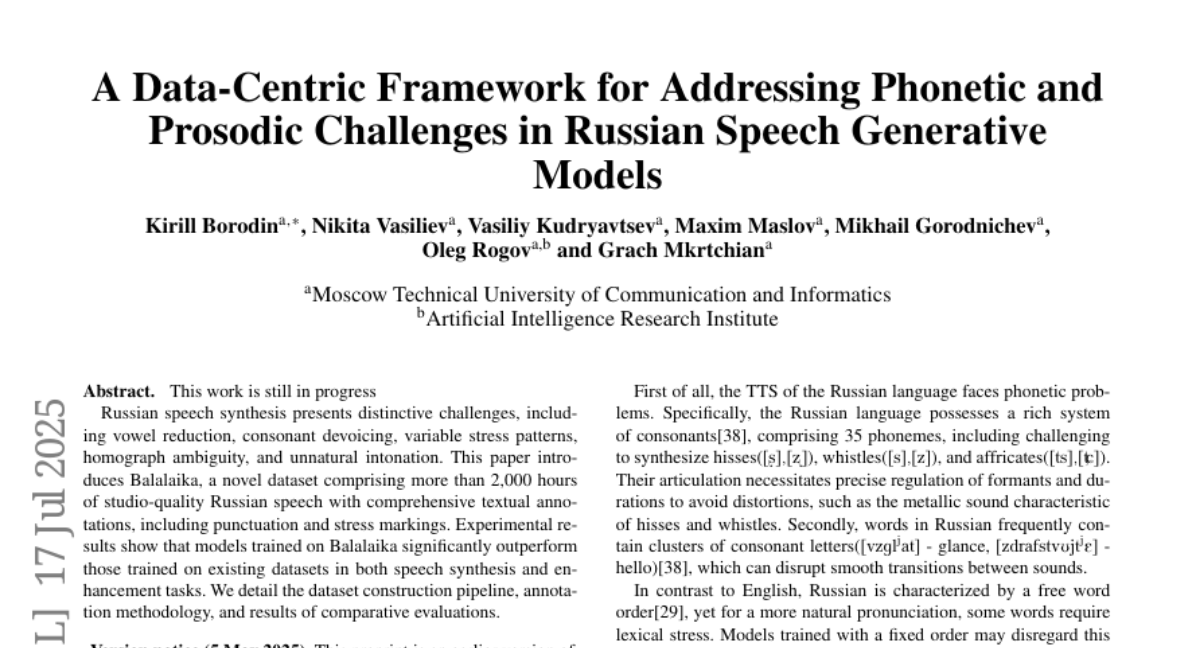
This paper talks about Balalaika, a large, high-quality dataset of Russian speech designed to help computers generate and improve Russian speech in a more natural and accurate way.
What's the problem?
The problem is that Russian speech is very complicated due to things like vowel reduction, changes in how consonants sound, different stress patterns in words, and tricky pronunciation rules, which makes it hard for current speech models to sound natural and correct.
What's the solution?
The authors created Balalaika, which contains over 2,000 hours of studio-recorded Russian speech with detailed annotations including punctuation and stress markings. This helps models learn better how to pronounce and emphasize words correctly, leading to more natural speech synthesis and enhancement.
Why it matters?
This matters because better datasets like Balalaika enable AI to generate Russian speech that sounds more natural and clear, which can improve voice assistants, translation, and communication technologies for Russian speakers.
Abstract
Balalaika, a new Russian speech dataset, improves speech synthesis and enhancement through comprehensive annotations and large-scale data.