A Survey of Efficient Reasoning for Large Reasoning Models: Language, Multimodality, and Beyond
Xiaoye Qu, Yafu Li, Zhaochen Su, Weigao Sun, Jianhao Yan, Dongrui Liu, Ganqu Cui, Daizong Liu, Shuxian Liang, Junxian He, Peng Li, Wei Wei, Jing Shao, Chaochao Lu, Yue Zhang, Xian-Sheng Hua, Bowen Zhou, Yu Cheng
2025-03-31
Summary
This paper looks at how to make AI reasoning models more efficient, as they often produce long and repetitive explanations.
What's the problem?
AI models that reason can be inefficient, generating unnecessarily long explanations with redundant information.
What's the solution?
This survey reviews recent efforts to improve the efficiency of AI reasoning models, from how they're trained to how they're used.
Why it matters?
This work matters because making AI reasoning models more efficient is crucial for their real-world deployment, especially where resources are limited.
Abstract
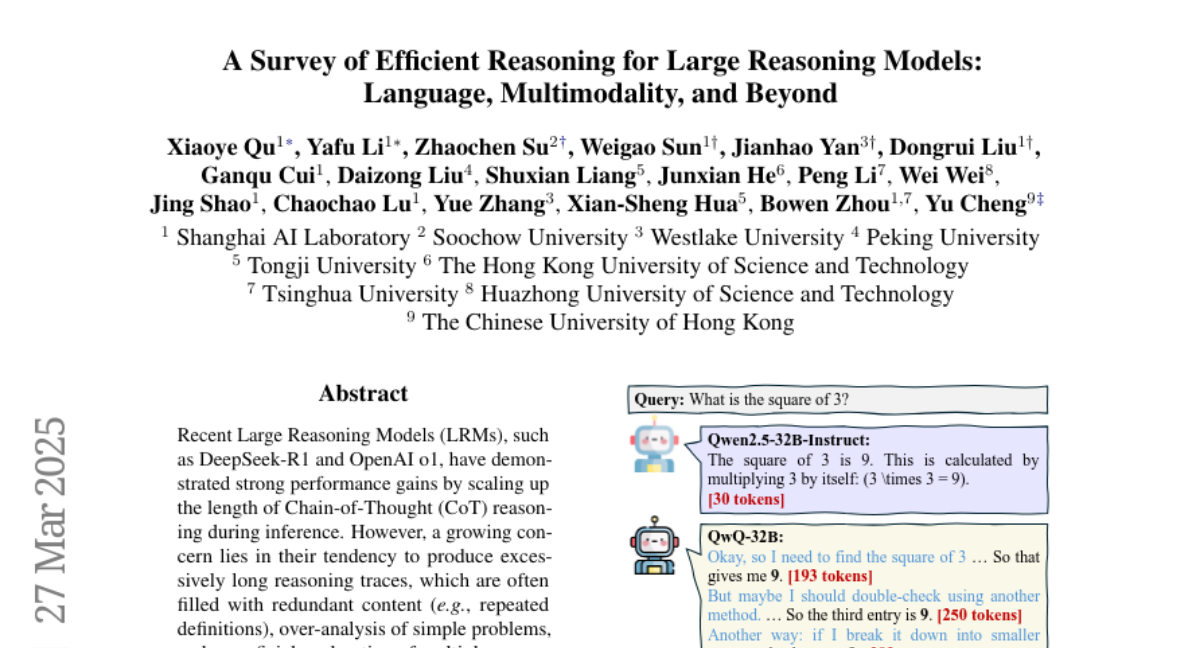
Recent Large Reasoning Models (LRMs), such as DeepSeek-R1 and OpenAI o1, have demonstrated strong performance gains by scaling up the length of Chain-of-Thought (CoT) reasoning during inference. However, a growing concern lies in their tendency to produce excessively long reasoning traces, which are often filled with redundant content (e.g., repeated definitions), over-analysis of simple problems, and superficial exploration of multiple reasoning paths for harder tasks. This inefficiency introduces significant challenges for training, inference, and real-world deployment (e.g., in agent-based systems), where token economy is critical. In this survey, we provide a comprehensive overview of recent efforts aimed at improving reasoning efficiency in LRMs, with a particular focus on the unique challenges that arise in this new paradigm. We identify common patterns of inefficiency, examine methods proposed across the LRM lifecycle, i.e., from pretraining to inference, and discuss promising future directions for research. To support ongoing development, we also maintain a real-time GitHub repository tracking recent progress in the field. We hope this survey serves as a foundation for further exploration and inspires innovation in this rapidly evolving area.