AgentsNet: Coordination and Collaborative Reasoning in Multi-Agent LLMs
Florian Grötschla, Luis Müller, Jan Tönshoff, Mikhail Galkin, Bryan Perozzi
2025-07-16
Summary
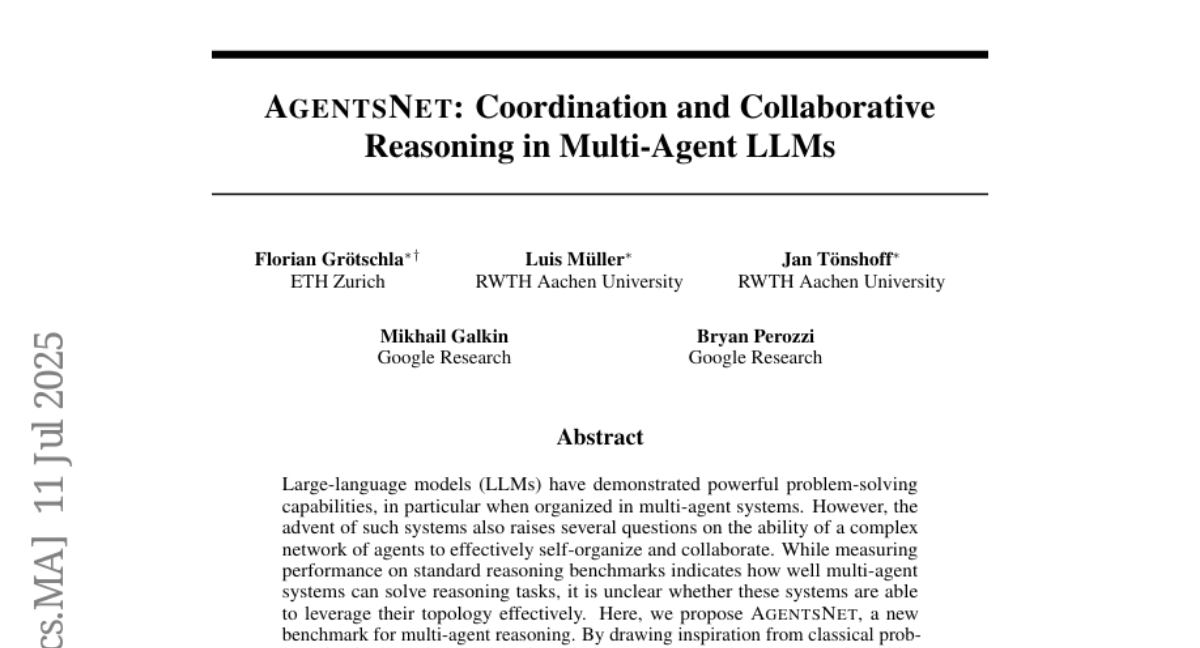
This paper talks about AgentsNet, a new way to test how well multiple AI agents can work together, organize themselves, and communicate to solve problems when they are connected in networks of different sizes.
What's the problem?
The problem is that while large language models are good at solving problems on their own, it’s unclear how well they can cooperate and coordinate as a group, especially as the number of agents grows larger, because existing tests usually involve very few agents.
What's the solution?
AgentsNet uses problems inspired by distributed computing and graph theory, like leader election and consensus, to create tasks that require groups of agents to communicate, organize leadership, and collaborate effectively. It also includes systems to test large groups of up to 100 agents, much larger than previous tests.
Why it matters?
This matters because real-world AI systems often need many agents working together, so understanding how well they coordinate and communicate is important to build better, more scalable, and smarter AI networks for complex tasks.
Abstract
AgentsNet is a new benchmark for evaluating multi-agent systems' ability to self-organize, communicate, and solve problems collaboratively across varying network sizes.