An Embarrassingly Simple Defense Against LLM Abliteration Attacks
Harethah Abu Shairah, Hasan Abed Al Kader Hammoud, Bernard Ghanem, George Turkiyyah
2025-05-27
Summary
This paper talks about a straightforward way to protect large language models from a type of attack called ablation attacks, which try to make the model give out information or behave in ways it shouldn't.
What's the problem?
The problem is that large language models can sometimes be tricked into ignoring their safety rules and giving out harmful or restricted information. These attacks, called ablation attacks, can make the models less trustworthy and safe to use.
What's the solution?
The authors fixed this by fine-tuning the models with a special dataset that teaches them to give clear and justified refusals when asked to do something unsafe or inappropriate. This makes the model better at saying 'no' for the right reasons, without hurting its ability to answer normal questions.
Why it matters?
This is important because it helps keep AI systems safe and reliable, making sure they follow the rules and protect users from harmful content, while still being helpful in everyday situations.
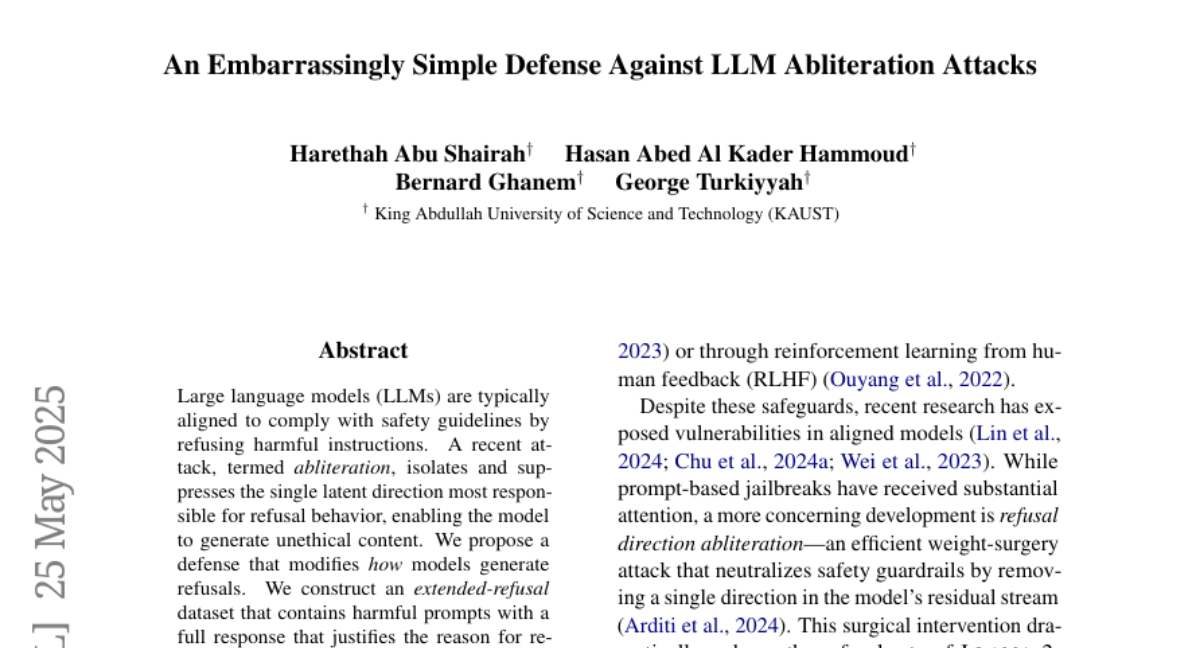
Abstract
Modifying models to generate justified refusals through fine-tuning on an extended-refusal dataset mitigates ablation attacks while maintaining high refusal rates and general performance.