Antidistillation Sampling
Yash Savani, Asher Trockman, Zhili Feng, Avi Schwarzschild, Alexander Robey, Marc Finzi, J. Zico Kolter
2025-04-18
Summary
This paper talks about antidistillation sampling, a new technique that changes how an AI model decides what word or token to generate next, specifically to make it harder for others to copy its step-by-step reasoning process.
What's the problem?
The problem is that when language models show their reasoning steps, other people or companies can use this information to train their own models, basically copying the original model's unique way of thinking. This can be a problem for companies that want to protect their intellectual property or prevent their models from being easily cloned.
What's the solution?
The researchers came up with a way to tweak the model's output so that its answers are just as good, but the detailed reasoning steps it shows are scrambled or disrupted. This makes it much harder for someone to use those traces to train a copycat model, without actually hurting the model's performance or usefulness.
Why it matters?
This matters because it helps protect the originality and value of advanced AI models, making it more difficult for others to steal or duplicate their special abilities, while still letting the models work well for users.
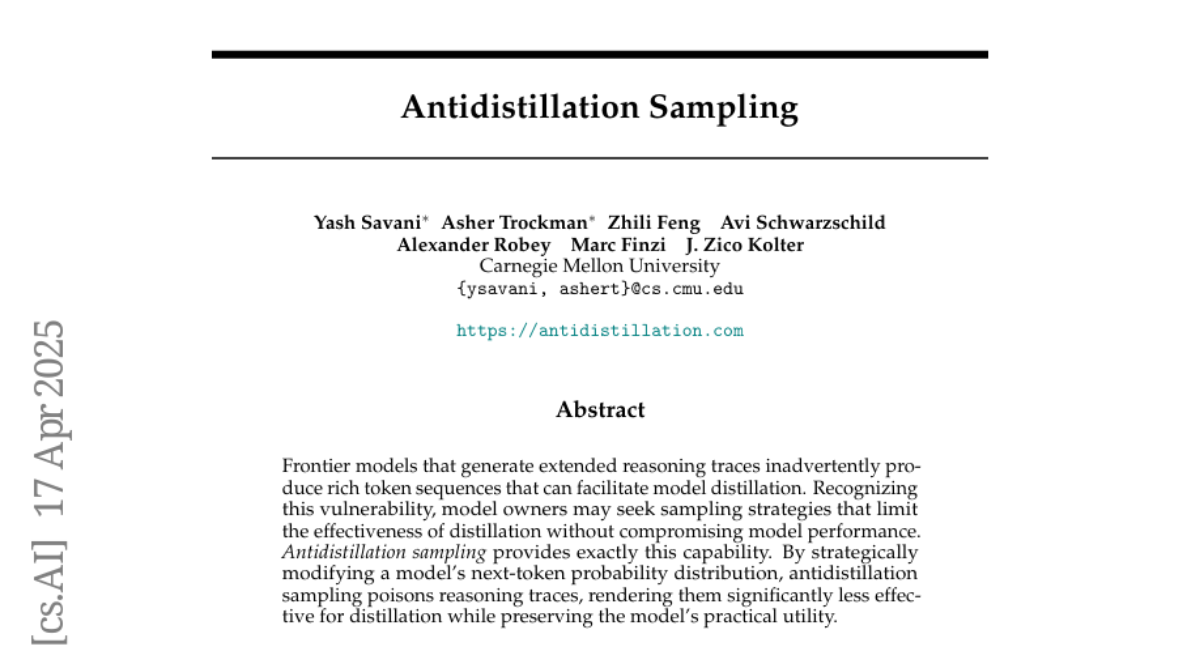
Abstract
Antidistillation sampling modifies a model's next-token probability distribution to disrupt the generation of reasoning traces for distillation without affecting model performance.