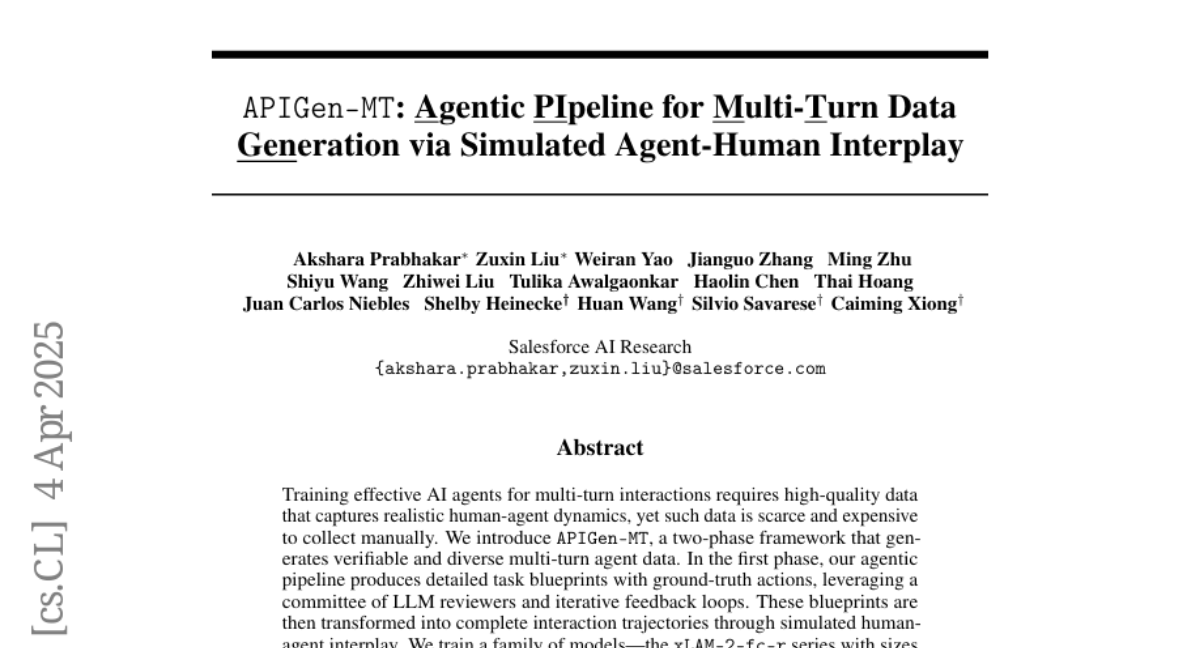
APIGen-MT: Agentic Pipeline for Multi-Turn Data Generation via Simulated Agent-Human Interplay
Akshara Prabhakar, Zuxin Liu, Weiran Yao, Jianguo Zhang, Ming Zhu, Shiyu Wang, Zhiwei Liu, Tulika Awalgaonkar, Haolin Chen, Thai Hoang, Juan Carlos Niebles, Shelby Heinecke, Huan Wang, Silvio Savarese, Caiming Xiong
2025-04-07
Summary
This paper talks about APIGen-MT, a tool that creates realistic practice conversations between humans and AI helpers to train smarter virtual assistants.
What's the problem?
Training AI for multi-step conversations (like customer service bots) needs tons of real chat examples, which are hard and expensive to collect.
What's the solution?
APIGen-MT first makes detailed task plans checked by AI reviewers, then turns them into fake chats using AI-human roleplay. Smaller AI models trained this way beat bigger ones like GPT-4 in tests.
Why it matters?
This helps create better AI assistants for apps like tech support or tutoring that can handle complex conversations without needing huge resources.
Abstract
Training effective AI agents for multi-turn interactions requires high-quality data that captures realistic human-agent dynamics, yet such data is scarce and expensive to collect manually. We introduce APIGen-MT, a two-phase framework that generates verifiable and diverse multi-turn agent data. In the first phase, our agentic pipeline produces detailed task blueprints with ground-truth actions, leveraging a committee of LLM reviewers and iterative feedback loops. These blueprints are then transformed into complete interaction trajectories through simulated human-agent interplay. We train a family of models -- the xLAM-2-fc-r series with sizes ranging from 1B to 70B parameters. Our models outperform frontier models such as GPT-4o and Claude 3.5 on tau-bench and BFCL benchmarks, with the smaller models surpassing their larger counterparts, particularly in multi-turn settings, while maintaining superior consistency across multiple trials. Comprehensive experiments demonstrate that our verified blueprint-to-details approach yields high-quality training data, enabling the development of more reliable, efficient, and capable agents. We open-source both the synthetic data collected and the trained xLAM-2-fc-r models to advance research in AI agents. Models are available on HuggingFace at https://huggingface.co/collections/Salesforce/xlam-2-67ef5be12949d8dcdae354c4 and project website is https://apigen-mt.github.io