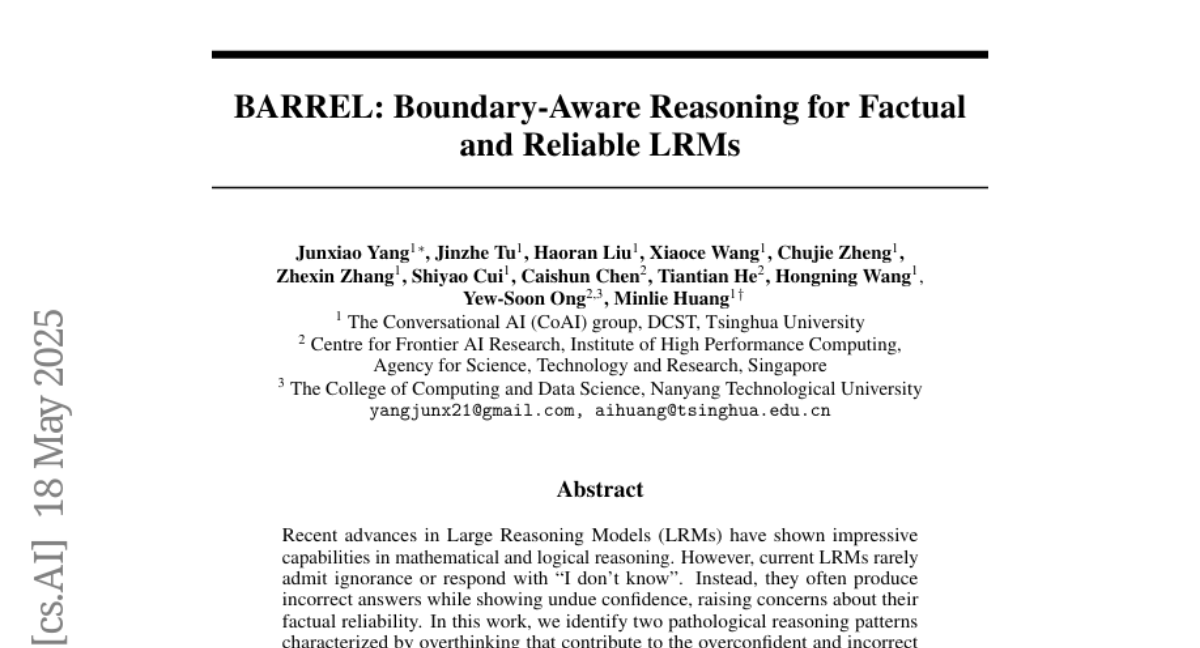
BARREL: Boundary-Aware Reasoning for Factual and Reliable LRMs
Junxiao Yang, Jinzhe Tu, Haoran Liu, Xiaoce Wang, Chujie Zheng, Zhexin Zhang, Shiyao Cui, Caishun Chen, Tiantian He, Hongning Wang, Yew-Soon Ong, Minlie Huang
2025-05-22
Summary
This paper talks about BARREL, a new method designed to make large reasoning models, which are advanced AI systems, give more factual and reliable answers by helping them avoid being overly confident when they're unsure.
What's the problem?
Large reasoning models are good at solving complex problems, but they often act too confident and rarely admit when they don't know something, which leads to them giving wrong answers that sound convincing. This overconfidence is made worse by patterns like last-minute guessing and overthinking, where the model keeps changing its mind or makes a wild guess at the end.
What's the solution?
The researchers created the BARREL framework, which trains these models to be more concise and aware of their own limits, so they stick to the facts and are less likely to make things up or pretend to know everything. This approach significantly improved the reliability of the models in their tests.
Why it matters?
This matters because it helps build AI systems that people can trust to give correct and honest answers, which is especially important for things like education, research, and decision-making where accuracy really counts.
Abstract
A novel framework, BARREL, addresses overconfidence in Large Reasoning Models by promoting concise and factual reasoning, significantly improving their reliability.