Benchmarking LLMs' Swarm intelligence
Kai Ruan, Mowen Huang, Ji-Rong Wen, Hao Sun
2025-05-08
Summary
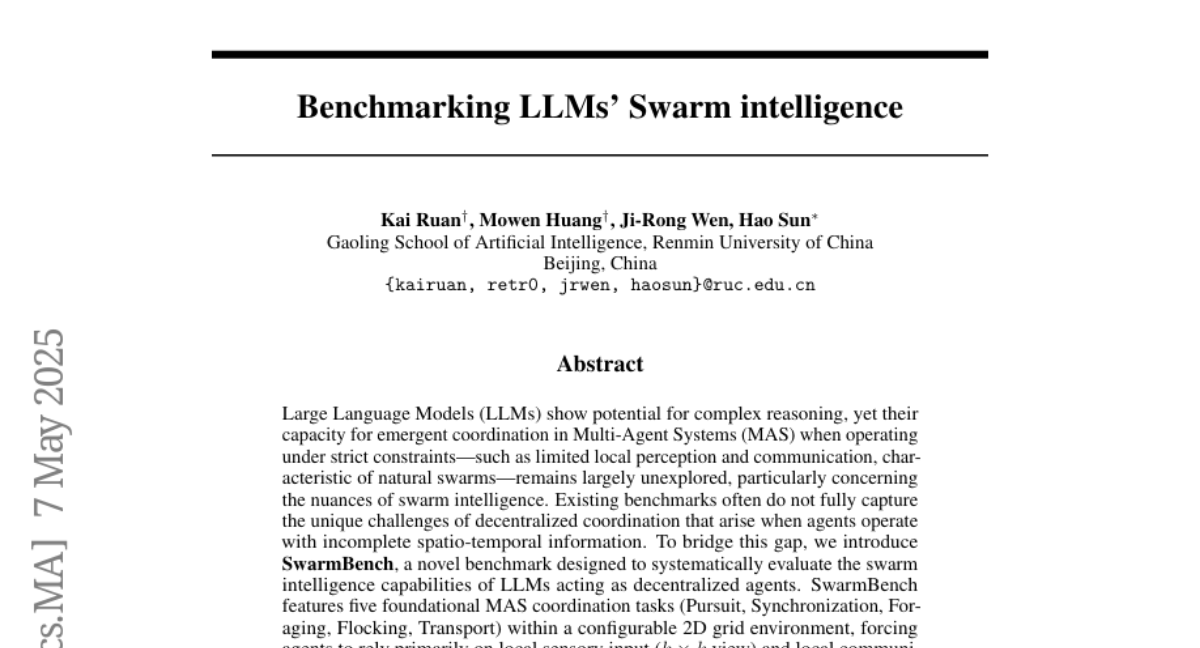
This paper talks about a new way to test how well large language models can work together like a swarm, meaning they have to coordinate with each other without having all the information, similar to how groups of animals like bees or birds do.
What's the problem?
The problem is that while language models are good at solving problems on their own, it's much harder for them to work together as a group when each model only knows a little bit of the whole situation. This kind of teamwork is important for building smarter and more flexible AI systems, but there hasn't been a good way to measure how well language models handle these kinds of group tasks.
What's the solution?
The researchers created a special benchmark, or test, that puts language models in situations where they have to coordinate and make decisions together without knowing everything. This helps reveal what challenges the models face and where they still need improvement when it comes to acting like a swarm.
Why it matters?
This matters because if AI models can get better at working together in groups, they could help solve bigger and more complicated problems in the real world. Understanding their strengths and weaknesses in these situations will help researchers design even smarter and more useful AI systems in the future.
Abstract
New benchmark evaluates LLMs in decentralized coordination tasks under limited information, highlighting challenges and potential for future systems.