Beyond the Linear Separability Ceiling
Enrico Vompa, Tanel Tammet, Mohit Vaishnav
2025-07-11
Summary
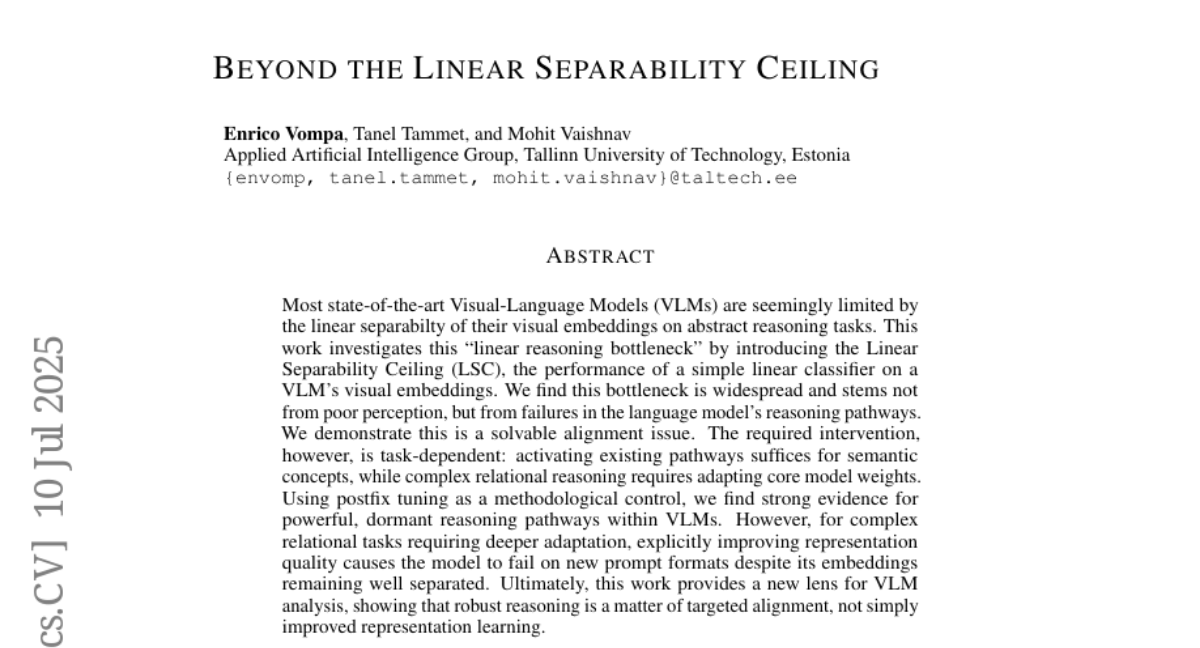
This paper talks about how visual-language models (VLMs), which combine images and text to understand and reason, face a limit called the linear separability ceiling that stops them from doing well on abstract thinking tasks.
What's the problem?
The issue is not with the model’s ability to see or recognize images, but with how the language part of the model processes and reasons about what it sees. The reasoning pathways aren’t aligned properly, so the model can’t fully use its potential to solve harder problems.
What's the solution?
The researchers created a way to measure this limit and showed that activating certain hidden reasoning pathways or adjusting parts of the model can break past this limit. They also found that improving visual representations alone can sometimes backfire, making the model less flexible with new types of questions.
Why it matters?
This matters because it helps us understand that making AI better at visual reasoning is not just about better seeing, but about smarter thinking. It suggests that fixing reasoning alignment is key to creating more capable and reliable AI that truly understands complex visual tasks.
Abstract
Visual-Language Models are limited by linear separability of visual embeddings in abstract reasoning tasks, which can be addressed through targeted alignment rather than improved representation learning.