BiomedSQL: Text-to-SQL for Scientific Reasoning on Biomedical Knowledge Bases
Mathew J. Koretsky, Maya Willey, Adi Asija, Owen Bianchi, Chelsea X. Alvarado, Tanay Nayak, Nicole Kuznetsov, Sungwon Kim, Mike A. Nalls, Daniel Khashabi, Faraz Faghri
2025-05-28
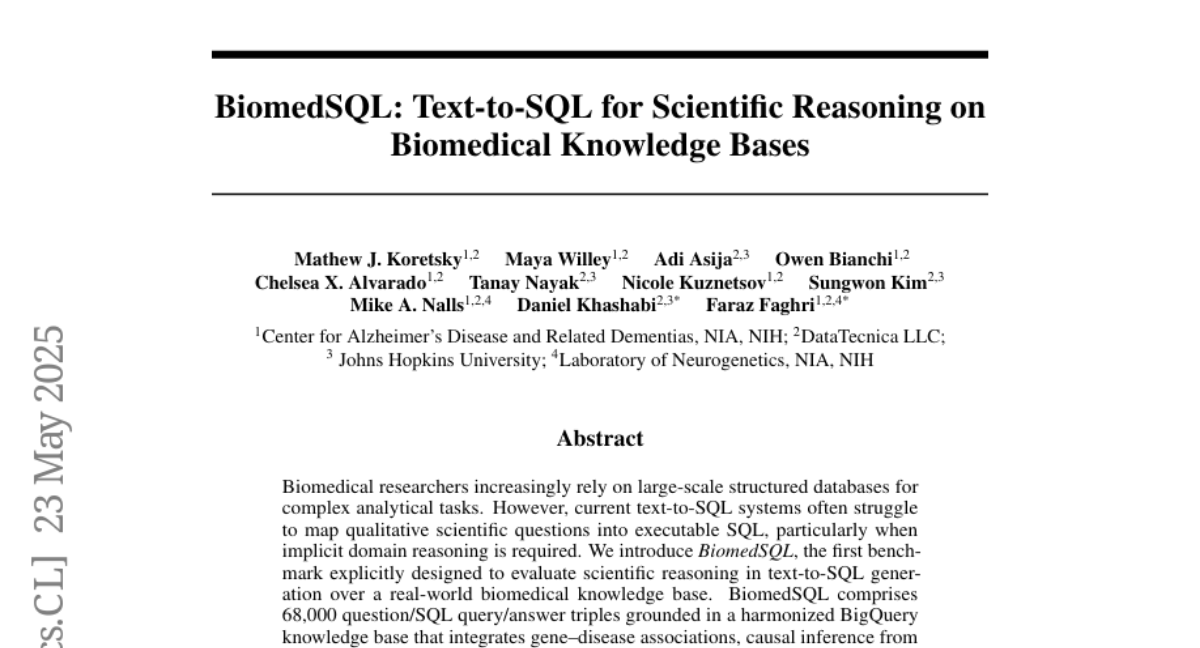
Summary
This paper talks about BiomedSQL, a new way to test how well AI models can turn scientific questions written in plain language into computer code that searches through huge medical databases.
What's the problem?
The problem is that even though AI models are getting better at understanding language, they still struggle to accurately translate complex scientific questions into the specific code needed to find answers in biomedical databases. This makes it hard for researchers and doctors to get the information they need quickly and correctly.
What's the solution?
To address this, the researchers created BiomedSQL, which tests AI models on their ability to handle text-to-SQL tasks in the biomedical field. By using a large and detailed medical knowledge base, BiomedSQL helps show where current models are falling short and what kinds of scientific reasoning they still need to improve.
Why it matters?
This is important because better AI for searching medical databases can help scientists and healthcare workers find important information faster, leading to better research and improved patient care.
Abstract
BiomedSQL evaluates scientific reasoning in text-to-SQL tasks using a large biomedical knowledge base, highlighting performance gaps in existing models.