BlenderGym: Benchmarking Foundational Model Systems for Graphics Editing
Yunqi Gu, Ian Huang, Jihyeon Je, Guandao Yang, Leonidas Guibas
2025-04-14
Summary
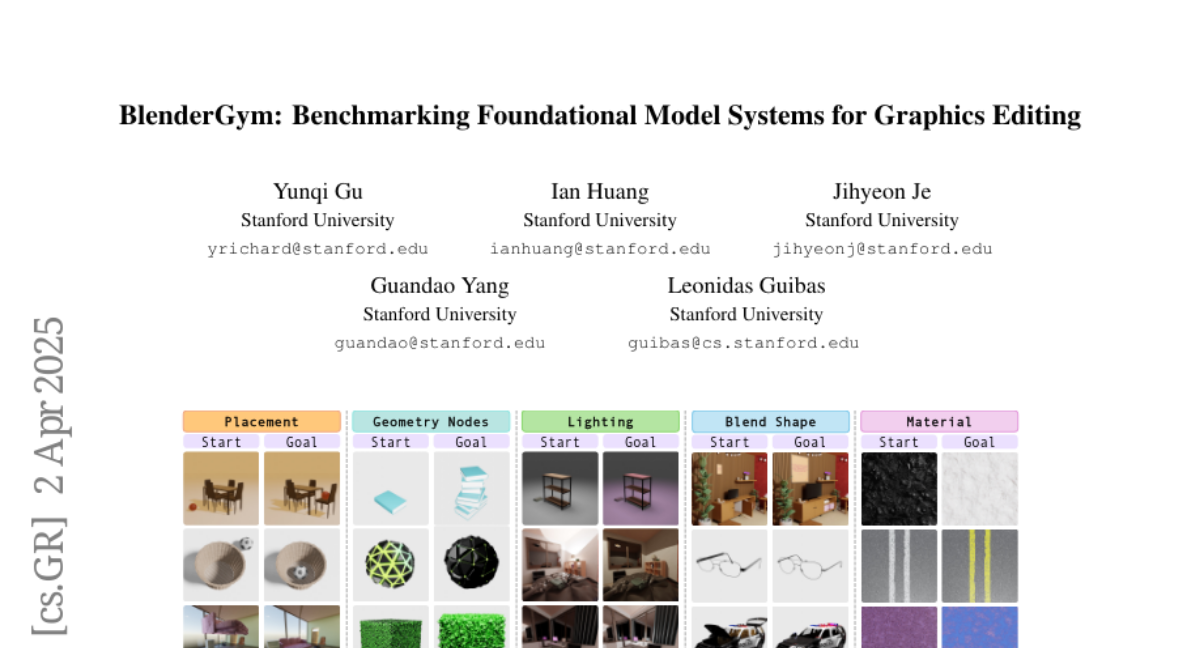
This paper talks about BlenderGym, a new way to test how well AI models can edit 3D graphics, like changing shapes or colors in a digital scene. BlenderGym acts as a benchmark, which means it's a set of challenges designed to measure how good these AI systems really are at graphics editing tasks.
What's the problem?
The problem is that even the most advanced AI models that understand both pictures and words still have a hard time doing 3D editing tasks that are easy for humans, like moving objects around or making simple changes in a scene. This shows that current AI is not as skilled as people when it comes to actually working with graphics, and it also raises questions about how AI uses computer resources for creating and checking its own work.
What's the solution?
The researchers created BlenderGym as a controlled environment where different AI models can be tested and compared on a variety of 3D editing tasks. By running these tests, they found out where the AI models struggle and suggested that future systems should be designed to better balance the computer power used for making changes (generation) and for checking if those changes are correct (verification).
Why it matters?
This work matters because it helps developers see exactly where AI still falls short compared to humans in graphics editing, which is important for making better creative tools. BlenderGym also points to smarter ways to use computer resources, which could make future AI models more efficient and effective at helping people with digital art, design, and animation.
Abstract
BlenderGym, a benchmark for 3D graphics editing, reveals that even advanced vision-language models struggle with tasks easily handled by human users and suggests optimizing computational resources between generation and verification.