BOP Challenge 2024 on Model-Based and Model-Free 6D Object Pose Estimation
Van Nguyen Nguyen, Stephen Tyree, Andrew Guo, Mederic Fourmy, Anas Gouda, Taeyeop Lee, Sungphill Moon, Hyeontae Son, Lukas Ranftl, Jonathan Tremblay, Eric Brachmann, Bertram Drost, Vincent Lepetit, Carsten Rother, Stan Birchfield, Jiri Matas, Yann Labbe, Martin Sundermeyer, Tomas Hodan
2025-04-08
Summary
This paper talks about the BOP Challenge 2024, a competition where AI teams try to teach computers to figure out exactly where objects are in 3D space (position and rotation) using real-world camera images, even when they've never seen those objects before.
What's the problem?
Current AI systems struggle to accurately track 3D objects in messy real-world settings (like cluttered rooms or moving scenes) without pre-made 3D models or prior knowledge of the objects.
What's the solution?
The challenge introduced new real-world test scenarios with AR/VR-style camera views, letting teams develop AI that can learn objects just from short videos and work without pre-loaded 3D blueprints.
Why it matters?
This pushes AI closer to real-world uses like robot assistants that can grab unfamiliar tools, AR apps that place virtual objects accurately in your room, and self-driving cars recognizing roadside items.
Abstract
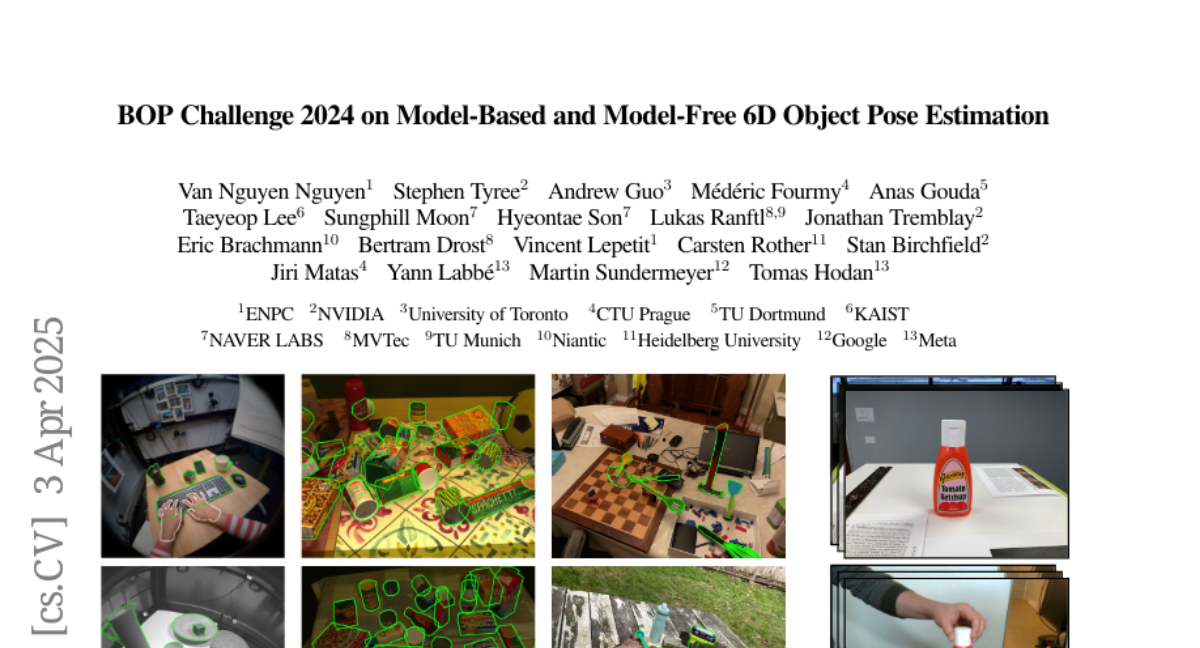
We present the evaluation methodology, datasets and results of the BOP Challenge 2024, the sixth in a series of public competitions organized to capture the state of the art in 6D object pose estimation and related tasks. In 2024, our goal was to transition BOP from lab-like setups to real-world scenarios. First, we introduced new model-free tasks, where no 3D object models are available and methods need to onboard objects just from provided reference videos. Second, we defined a new, more practical 6D object detection task where identities of objects visible in a test image are not provided as input. Third, we introduced new BOP-H3 datasets recorded with high-resolution sensors and AR/VR headsets, closely resembling real-world scenarios. BOP-H3 include 3D models and onboarding videos to support both model-based and model-free tasks. Participants competed on seven challenge tracks, each defined by a task, object onboarding setup, and dataset group. Notably, the best 2024 method for model-based 6D localization of unseen objects (FreeZeV2.1) achieves 22% higher accuracy on BOP-Classic-Core than the best 2023 method (GenFlow), and is only 4% behind the best 2023 method for seen objects (GPose2023) although being significantly slower (24.9 vs 2.7s per image). A more practical 2024 method for this task is Co-op which takes only 0.8s per image and is 25X faster and 13% more accurate than GenFlow. Methods have a similar ranking on 6D detection as on 6D localization but higher run time. On model-based 2D detection of unseen objects, the best 2024 method (MUSE) achieves 21% relative improvement compared to the best 2023 method (CNOS). However, the 2D detection accuracy for unseen objects is still noticealy (-53%) behind the accuracy for seen objects (GDet2023). The online evaluation system stays open and is available at http://bop.felk.cvut.cz/