BridgeVLA: Input-Output Alignment for Efficient 3D Manipulation Learning with Vision-Language Models
Peiyan Li, Yixiang Chen, Hongtao Wu, Xiao Ma, Xiangnan Wu, Yan Huang, Liang Wang, Tao Kong, Tieniu Tan
2025-06-17
Summary
This paper talks about BridgeVLA, a new AI model that helps robots or systems understand and act on 3D information by converting that 3D data into 2D images and using heatmaps to figure out what actions to take. This approach makes the process faster and more effective, and it works better than other models on different tests.
What's the problem?
The problem is that learning how to interact with 3D environments can be very complicated and slow because 3D data is hard to process directly. Many existing models try to work with 3D inputs as they are, which takes a lot of computing power and time, making it difficult for AI to efficiently learn how to manipulate objects or navigate spaces in three dimensions.
What's the solution?
The solution was to create BridgeVLA, which changes the 3D input into 2D images and generates 2D heatmaps that show where and how the model should act. By working with 2D representations, the model can predict actions more quickly and with less computational effort while still handling the complexity of 3D tasks. This method results in better performance and faster learning compared to models that work directly with 3D data.
Why it matters?
This matters because it helps improve the ability of AI systems to learn to manipulate objects and move in three-dimensional spaces more efficiently. Faster and more efficient learning means that robots and AI tools can be developed more quickly and used in real-world tasks like manufacturing, healthcare, or home assistance, where understanding and acting in 3D environments is essential.
Abstract
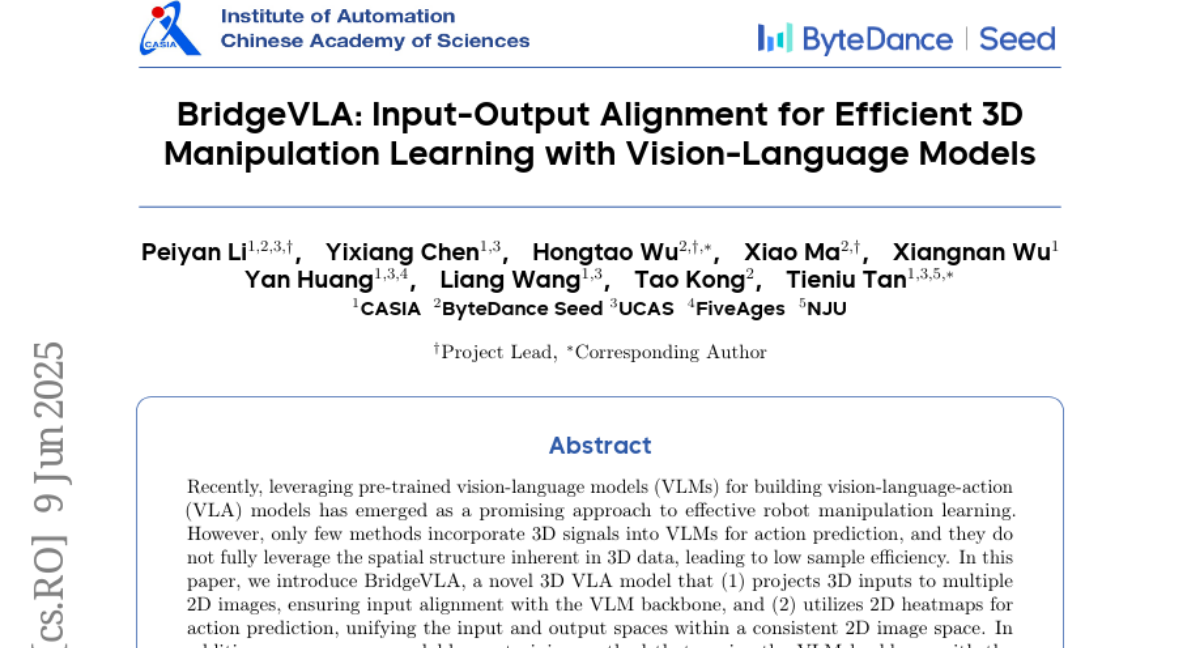
BridgeVLA is a 3D vision-language-action model that projects 3D inputs to 2D images and uses 2D heatmaps for efficient and effective action prediction, outperforming baselines in various benchmarks.