Bridging Evolutionary Multiobjective Optimization and GPU Acceleration via Tensorization
Zhenyu Liang, Hao Li, Naiwei Yu, Kebin Sun, Ran Cheng
2025-04-01
Summary
This paper is about making a certain type of problem-solving AI (called Evolutionary Multiobjective Optimization or EMO) much faster by using the power of computer graphics cards (GPUs).
What's the problem?
EMO algorithms are often slow, especially when dealing with complex problems.
What's the solution?
The researchers found a way to rewrite the EMO algorithms so they can easily run on GPUs, making them much faster.
Why it matters?
This work matters because it can make complex problem-solving much faster and more efficient, opening up new possibilities in fields like robotics and engineering.
Abstract
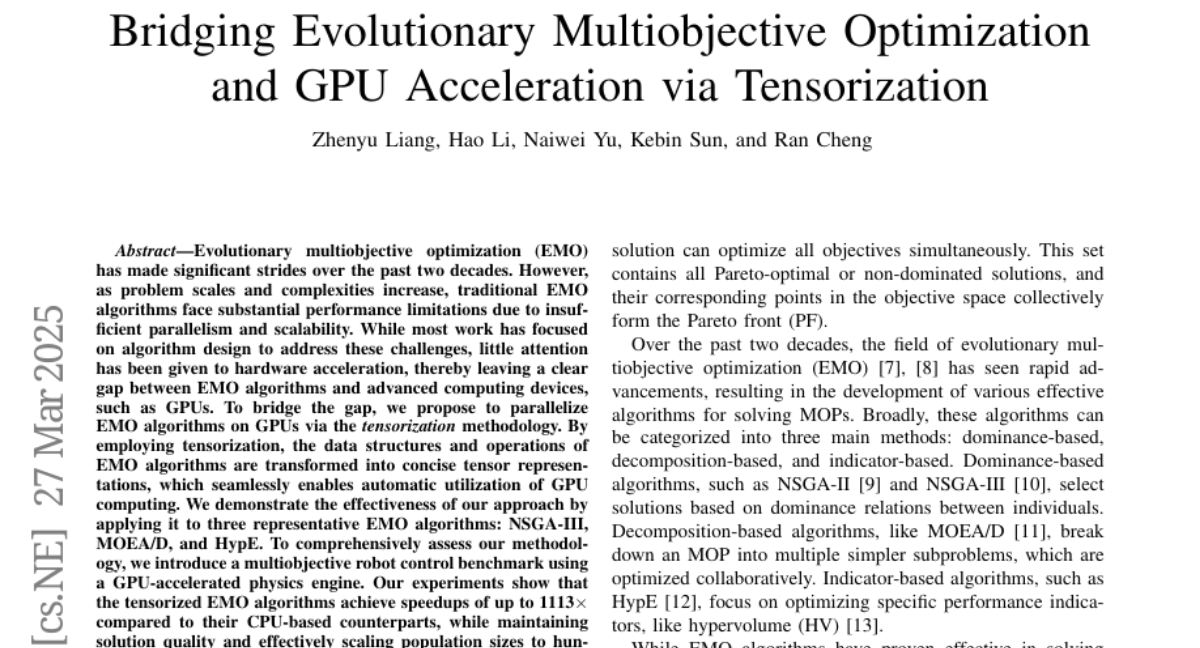
Evolutionary multiobjective optimization (EMO) has made significant strides over the past two decades. However, as problem scales and complexities increase, traditional EMO algorithms face substantial performance limitations due to insufficient parallelism and scalability. While most work has focused on algorithm design to address these challenges, little attention has been given to hardware acceleration, thereby leaving a clear gap between EMO algorithms and advanced computing devices, such as GPUs. To bridge the gap, we propose to parallelize EMO algorithms on GPUs via the tensorization methodology. By employing tensorization, the data structures and operations of EMO algorithms are transformed into concise tensor representations, which seamlessly enables automatic utilization of GPU computing. We demonstrate the effectiveness of our approach by applying it to three representative EMO algorithms: NSGA-III, MOEA/D, and HypE. To comprehensively assess our methodology, we introduce a multiobjective robot control benchmark using a GPU-accelerated physics engine. Our experiments show that the tensorized EMO algorithms achieve speedups of up to 1113x compared to their CPU-based counterparts, while maintaining solution quality and effectively scaling population sizes to hundreds of thousands. Furthermore, the tensorized EMO algorithms efficiently tackle complex multiobjective robot control tasks, producing high-quality solutions with diverse behaviors. Source codes are available at https://github.com/EMI-Group/evomo.