Can LLMs Identify Critical Limitations within Scientific Research? A Systematic Evaluation on AI Research Papers
Zhijian Xu, Yilun Zhao, Manasi Patwardhan, Lovekesh Vig, Arman Cohan
2025-07-04
Summary
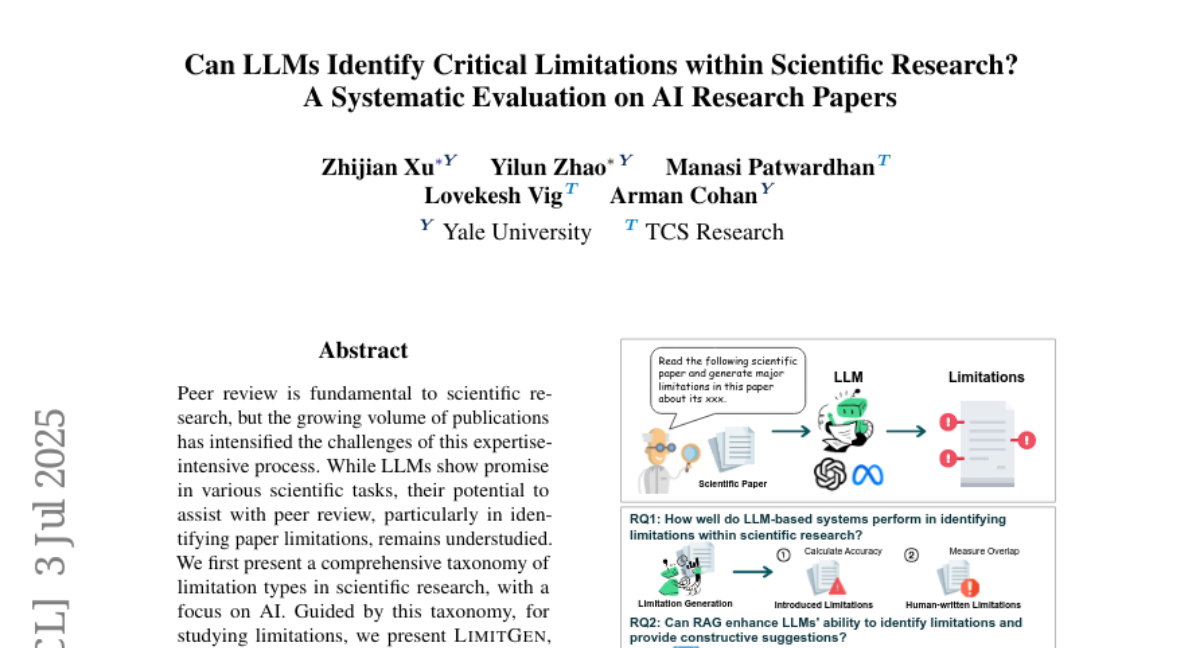
This paper talks about LimitGen, a new benchmark designed to test how well large language models (LLMs) can find weaknesses or limitations in scientific research papers, especially in AI. It uses both artificially created data and real human-written feedback to evaluate the models.
What's the problem?
The problem is that peer review, where experts check scientific papers for problems, is very hard to keep up with because so many papers are published. While LLMs can help with some tasks, it's unclear how good they are at identifying important flaws in research.
What's the solution?
The researchers created LimitGen, which focuses on different types of limitations in papers like methodology and experimental design. They made a synthetic dataset by intentionally adding problems to good papers and also collected real feedback from human reviewers. They improved LLM performance by adding a system that retrieves relevant scientific literature to help the models make better, more grounded critiques.
Why it matters?
This matters because having AI that can accurately spot problems in research papers would speed up the peer review process, help improve scientific work, and ensure higher quality research is shared with the world.
Abstract
A benchmark named LimitGen evaluates LLMs' ability to identify limitations in scientific papers, using synthetic and human-written datasets, and enhances their feedback with literature retrieval.