CoLMDriver: LLM-based Negotiation Benefits Cooperative Autonomous Driving
Changxing Liu, Genjia Liu, Zijun Wang, Jinchang Yang, Siheng Chen
2025-03-19
Summary
This paper explores how to make self-driving cars work together more smoothly by using AI to negotiate like humans.
What's the problem?
Self-driving cars often struggle to cooperate with each other because they have limited ways of communicating and planning together.
What's the solution?
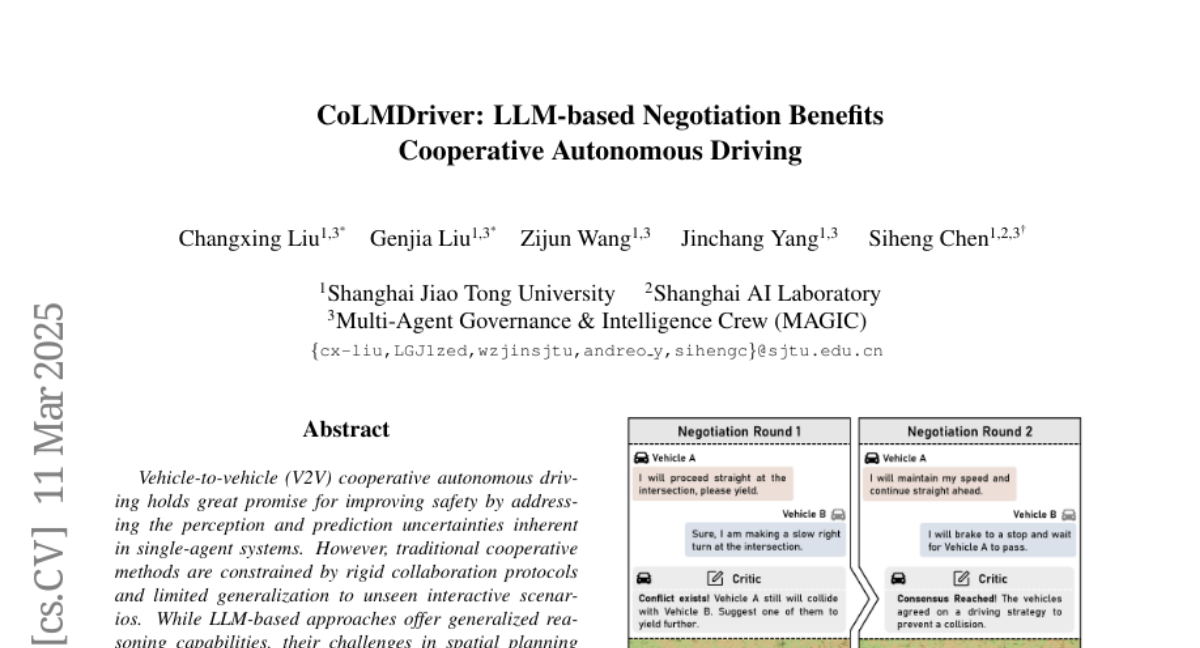
The researchers developed a system called CoLMDriver that uses AI to allow cars to negotiate with each other using language, making their cooperation more flexible and effective.
Why it matters?
This work matters because it can lead to safer and more efficient self-driving systems by improving how cars work together on the road.
Abstract
Vehicle-to-vehicle (V2V) cooperative autonomous driving holds great promise for improving safety by addressing the perception and prediction uncertainties inherent in single-agent systems. However, traditional cooperative methods are constrained by rigid collaboration protocols and limited generalization to unseen interactive scenarios. While LLM-based approaches offer generalized reasoning capabilities, their challenges in spatial planning and unstable inference latency hinder their direct application in cooperative driving. To address these limitations, we propose CoLMDriver, the first full-pipeline LLM-based cooperative driving system, enabling effective language-based negotiation and real-time driving control. CoLMDriver features a parallel driving pipeline with two key components: (i) an LLM-based negotiation module under an actor-critic paradigm, which continuously refines cooperation policies through feedback from previous decisions of all vehicles; and (ii) an intention-guided waypoint generator, which translates negotiation outcomes into executable waypoints. Additionally, we introduce InterDrive, a CARLA-based simulation benchmark comprising 10 challenging interactive driving scenarios for evaluating V2V cooperation. Experimental results demonstrate that CoLMDriver significantly outperforms existing approaches, achieving an 11% higher success rate across diverse highly interactive V2V driving scenarios. Code will be released on https://github.com/cxliu0314/CoLMDriver.