Compound AI Systems Optimization: A Survey of Methods, Challenges, and Future Directions
Yu-Ang Lee, Guan-Ting Yi, Mei-Yi Liu, Jui-Chao Lu, Guan-Bo Yang, Yun-Nung Chen
2025-06-15
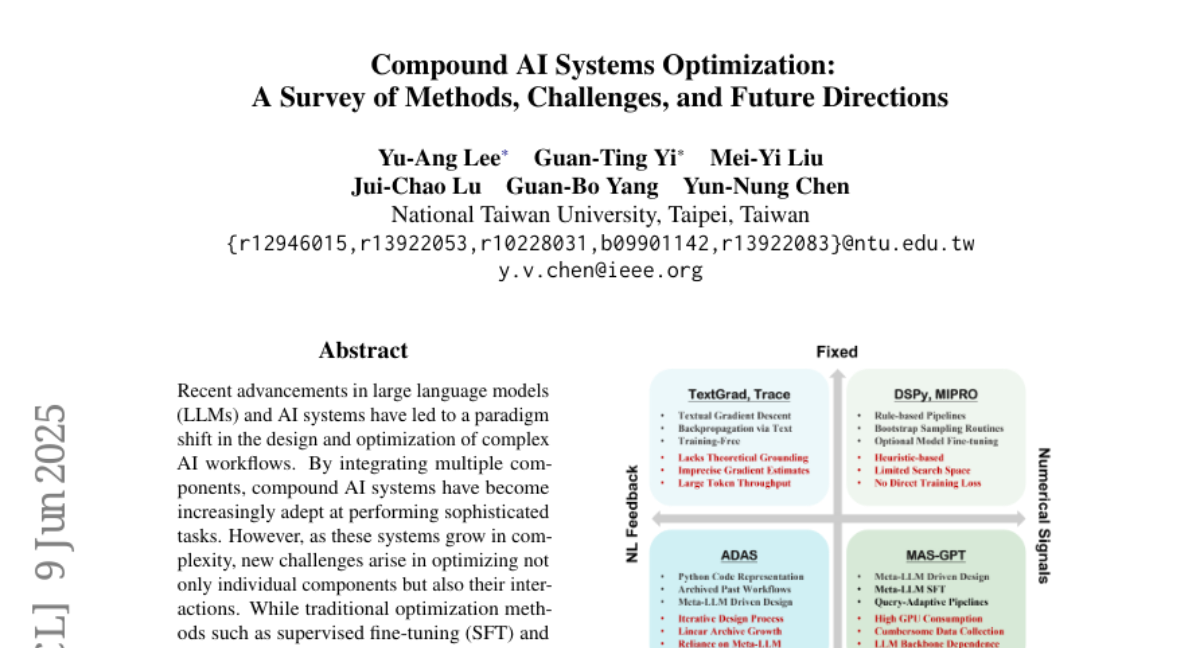
Summary
This paper talks about how compound AI systems are made by combining different AI parts to work together on hard problems instead of just using one AI model. It looks at new ways to make these systems better, especially by using natural language feedback to help improve parts that are hard to adjust with usual methods.
What's the problem?
The problem is that combining various AI models and tools into one system is very tricky. Each part is different and sometimes can't be easily changed or improved using normal training techniques because they don't allow smooth adjustments. This makes optimizing the whole system slow and difficult.
What's the solution?
The solution is to study and use new methods that help optimize these compound systems despite their complexity and non-differentiable components. One important approach is using natural language feedback, where the system gets instructions or corrections in everyday language to guide improvements without needing traditional training methods. The paper surveys various optimization techniques, challenges, and paths forward to address these issues.
Why it matters?
This matters because compound AI systems are becoming more common for solving complex problems by combining different AI tools and models. Finding better ways to optimize them means these systems can work faster, smarter, and more reliably, improving how AI helps with advanced tasks in many areas.
Abstract
Recent advancements in optimizing compound AI systems highlight challenges in integrating various components, with an emphasis on natural language feedback methods for non-differentiable systems.