Controlling Space and Time with Diffusion Models
Daniel Watson, Saurabh Saxena, Lala Li, Andrea Tagliasacchi, David J. Fleet
2024-07-11
Summary
This paper talks about 4DiM, a new model designed to create 4D views of scenes from images. It allows for generating new perspectives based on camera positions and times, helping to improve how we visualize and interact with 3D environments.
What's the problem?
The main problem is that there is not enough training data available for 4D models, which limits their ability to generate accurate and dynamic views of scenes. Traditional methods often rely on either 3D data with camera positions or video data without specific poses, making it hard to create realistic 4D representations.
What's the solution?
To solve this issue, the authors developed a cascaded diffusion model called 4DiM that can work with a mix of different types of data: 3D images with camera poses, 4D data that includes both poses and time, and videos that only have time information. They also introduced a new architecture that allows the model to learn effectively from these varied sources. Additionally, they improved the calibration of data using depth estimators to ensure accurate camera control. The model was evaluated using new metrics that better assess its performance in generating high-quality images and controlling camera positions.
Why it matters?
This research is important because it enhances our ability to generate realistic visualizations in various applications, such as virtual reality, gaming, and film production. By improving how we create and manipulate 4D views, 4DiM can lead to more immersive experiences and better tools for artists and developers working with complex visual data.
Abstract
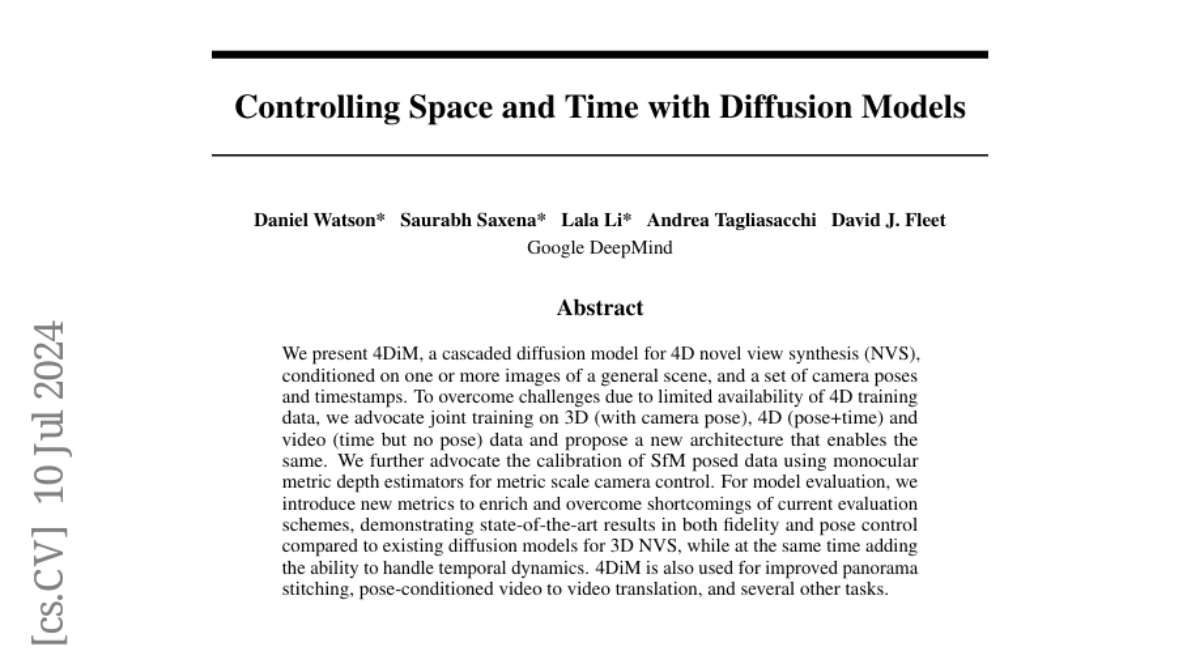
We present 4DiM, a cascaded diffusion model for 4D novel view synthesis (NVS), conditioned on one or more images of a general scene, and a set of camera poses and timestamps. To overcome challenges due to limited availability of 4D training data, we advocate joint training on 3D (with camera pose), 4D (pose+time) and video (time but no pose) data and propose a new architecture that enables the same. We further advocate the calibration of SfM posed data using monocular metric depth estimators for metric scale camera control. For model evaluation, we introduce new metrics to enrich and overcome shortcomings of current evaluation schemes, demonstrating state-of-the-art results in both fidelity and pose control compared to existing diffusion models for 3D NVS, while at the same time adding the ability to handle temporal dynamics. 4DiM is also used for improved panorama stitching, pose-conditioned video to video translation, and several other tasks. For an overview see https://4d-diffusion.github.io