CoRAG: Collaborative Retrieval-Augmented Generation
Aashiq Muhamed, Mona Diab, Virginia Smith
2025-04-14
Summary
This paper talks about CoRAG, a new system that helps AI models answer questions or create content by letting them work together and share information they’ve found, instead of each model working alone. CoRAG builds on an existing method called Retrieval-Augmented Generation (RAG) but adds a way for multiple users or clients to use a shared library of helpful information.
What's the problem?
The problem is that when different AI models or users try to learn or solve problems with very little data, it’s hard for them to find enough good information on their own. If they could share what they’ve found, they might all do better, but sharing also comes with risks, like mixing up information or getting confused by too many sources.
What's the solution?
CoRAG solves this by creating a shared passage store where all the clients can put useful information they’ve retrieved. The system is designed to balance the benefits of sharing—like learning from each other—with the risks, making sure the shared information actually helps everyone get better results, especially when there’s not much data to start with.
Why it matters?
This work matters because it shows a way for AI systems and users to work together more effectively, especially in situations where there isn’t a lot of data or examples. By sharing knowledge in a smart way, CoRAG helps everyone get better answers and opens up new possibilities for teamwork in AI.
Abstract
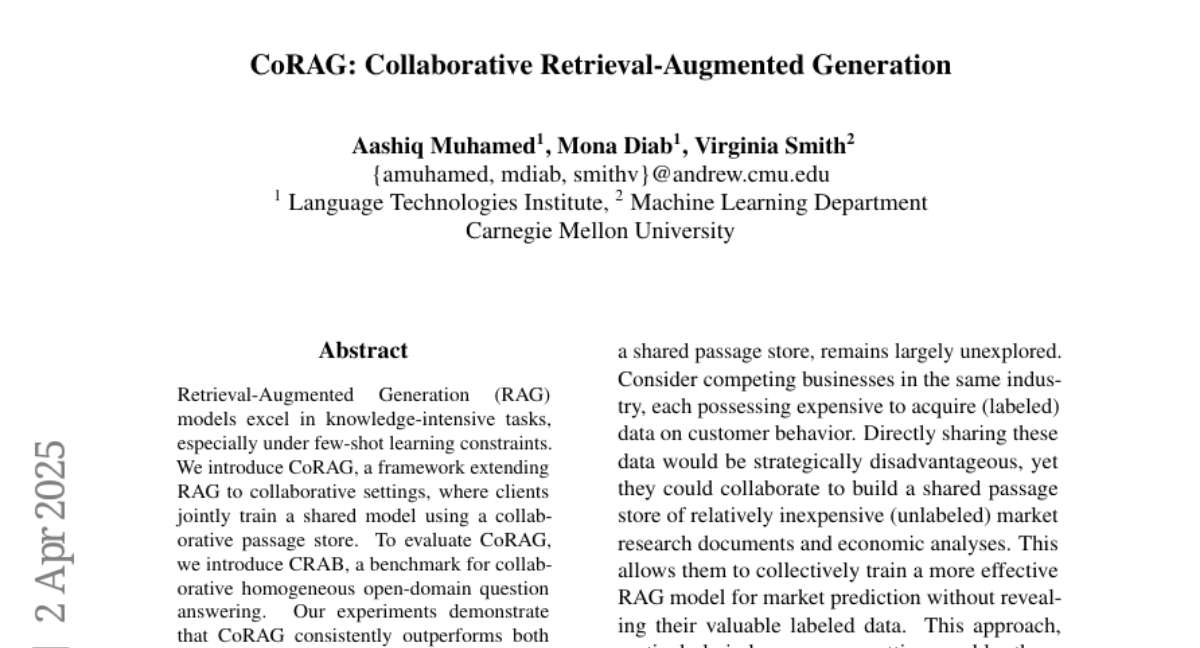
CoRAG, a collaborative framework extending RAG with a shared passage store, outperforms other methods in few-shot learning by balancing the benefits and risks of incorporating knowledge from multiple clients.