Creating General User Models from Computer Use
Omar Shaikh, Shardul Sapkota, Shan Rizvi, Eric Horvitz, Joon Sung Park, Diyi Yang, Michael S. Bernstein
2025-05-20
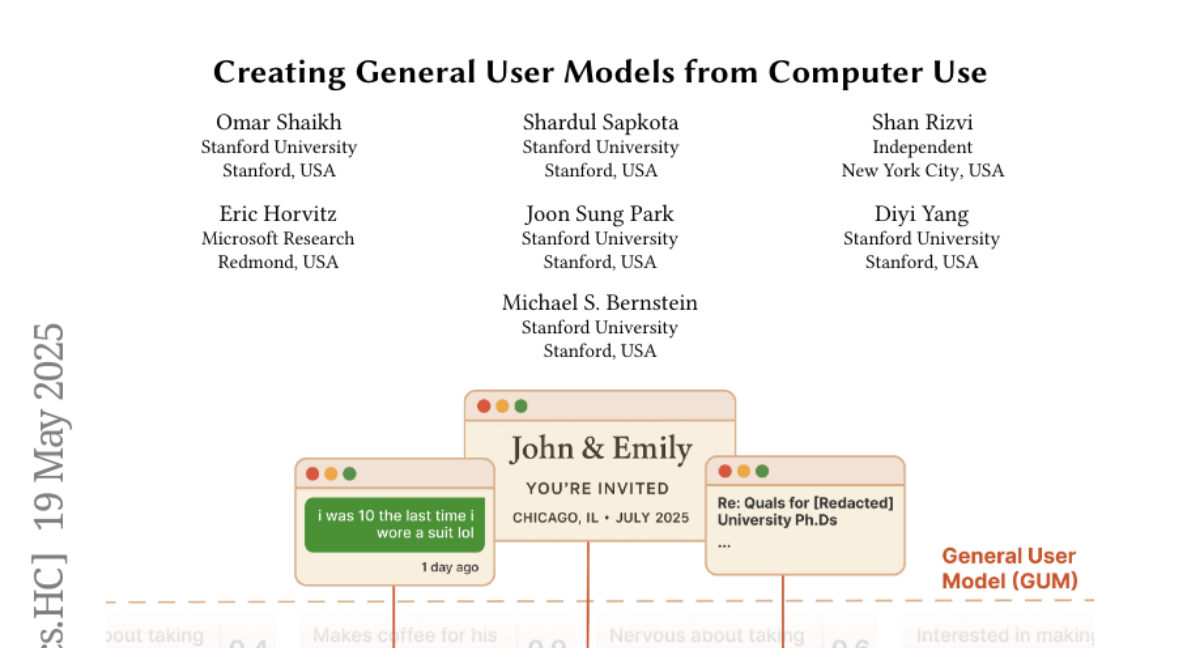
Summary
This paper talks about GUMs, a new type of AI system that learns about a person's habits and preferences just by watching how they use their computer, so it can help them better in the future.
What's the problem?
The problem is that most digital assistants and interactive programs don't really understand what each user likes or needs because they can't pick up on the small details of how people use their devices, which makes their help less personal and useful.
What's the solution?
To solve this, the researchers built a system that can observe all sorts of actions a user takes on their computer, like which programs they use and how they interact with them, and then uses this information to create a general model of that user's behavior. This allows the AI to guess what the user might want next and offer helpful suggestions without being asked.
Why it matters?
This matters because it could make digital assistants and other interactive tools much smarter and more helpful, giving people support that's actually tailored to their own routines and preferences.
Abstract
GUMs, a multimodal user model architecture, learns user preferences and habits from unstructured observations to enhance chat-based assistants and interactive agents by inferring context and making proactive suggestions.