Deciphering Trajectory-Aided LLM Reasoning: An Optimization Perspective
Junnan Liu, Hongwei Liu, Linchen Xiao, Shudong Liu, Taolin Zhang, Zihan Ma, Songyang Zhang, Kai Chen
2025-05-27
Summary
This paper talks about a new way to understand how large language models (LLMs) think through problems by comparing their reasoning process to how computers learn from experience, using ideas from optimization and meta-learning.
What's the problem?
The problem is that while LLMs can answer lots of questions, it's not always clear how they actually work through their reasoning steps, which makes it hard to improve them or know why they sometimes make mistakes.
What's the solution?
The researchers looked at LLM reasoning as if it were a kind of learning process called pseudo-gradient descent, where each question is treated like a separate task. By studying the model this way, they found ways to help it generalize better and offered new ideas for making LLMs smarter and more reliable.
Why it matters?
This is important because understanding how LLMs reason can lead to better AI systems that are easier to improve, more trustworthy, and able to handle a wider variety of questions and problems.
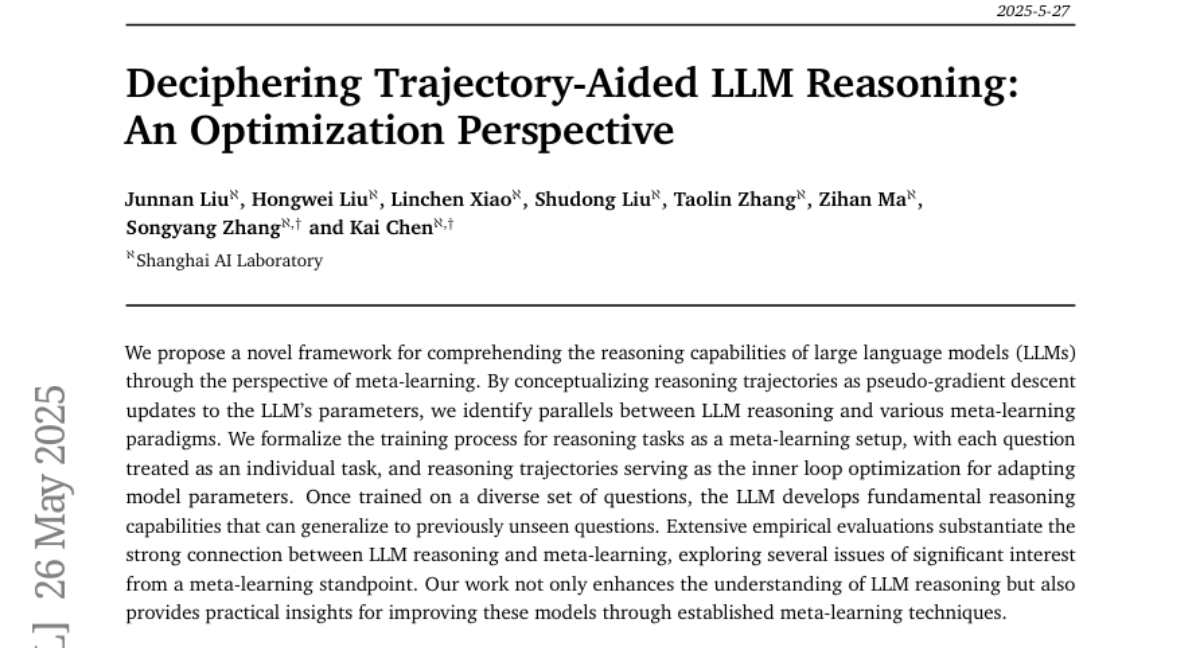
Abstract
LLM reasoning is understood through a meta-learning framework, treating reasoning as pseudo-gradient descent and questions as individual tasks, which enhances generalization and provides practical insights for improvement.