Decoder-Hybrid-Decoder Architecture for Efficient Reasoning with Long Generation
Liliang Ren, Congcong Chen, Haoran Xu, Young Jin Kim, Adam Atkinson, Zheng Zhan, Jiankai Sun, Baolin Peng, Liyuan Liu, Shuohang Wang, Hao Cheng, Jianfeng Gao, Weizhu Chen, Yelong Shen
2025-07-10
Summary
This paper talks about a Decoder-Hybrid-Decoder architecture that uses a special component called the Gated Memory Unit (GMU) to improve how AI models remember information and reason when generating long sequences of text.
What's the problem?
The problem is that current AI models have trouble efficiently handling long pieces of text because they either forget important details or require too much computing power, which slows them down and makes them less accurate.
What's the solution?
The researchers improved an architecture called SambaY by adding the GMU, which helps different parts of the model share memory better and decide what information to keep or ignore. This makes the model faster, reduces the chance of losing important details, and improves performance on tasks that need long-term understanding.
Why it matters?
This matters because it allows AI to work more efficiently with long documents or conversations, making it better at tasks like reading, summarizing, and solving complex problems that require remembering a lot of information over time.
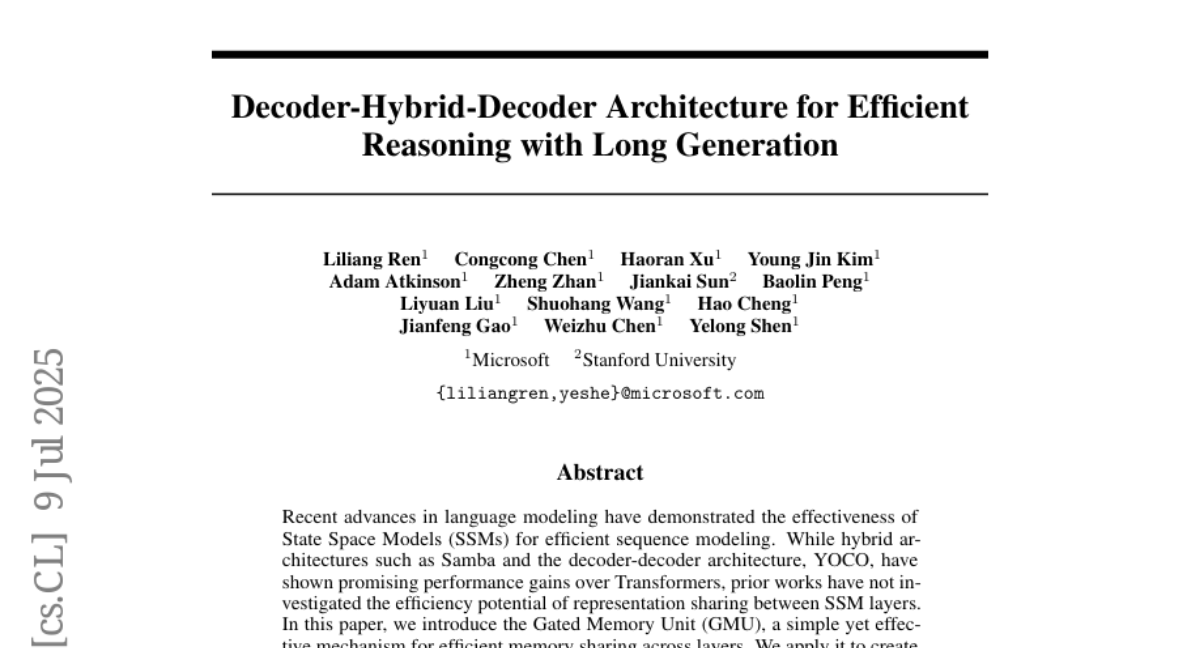
Abstract
Gated Memory Unit (GMU) enhances SambaY architecture, improving decoding efficiency and long-context performance while reducing irreducible loss and increasing throughput.