Differential Information: An Information-Theoretic Perspective on Preference Optimization
Yunjae Won, Hyunji Lee, Hyeonbin Hwang, Minjoon Seo
2025-05-30
Summary
This paper talks about how to use information theory to better understand and improve the way AI models learn from human preferences, especially when tuning how they make decisions based on what people like.
What's the problem?
The problem is that while methods like Direct Preference Optimization (DPO) help AI models match human preferences, it's not always clear why certain mathematical approaches work best for teaching the model to act the way we want, and how to make this process as effective as possible.
What's the solution?
The researchers analyzed preference optimization using ideas from information theory and showed that the best way to train an AI model is to use a log-ratio reward, which compares how likely the model is to pick a certain answer compared to a reference model. They proved that this method is optimal for learning from preferences and explained how it connects to the structure of the model's decision-making and the concept of information entropy, which measures uncertainty.
Why it matters?
This is important because it gives a solid mathematical foundation for why DPO works so well, helping researchers design even better AI systems that can learn more efficiently from human feedback and make more reliable decisions.
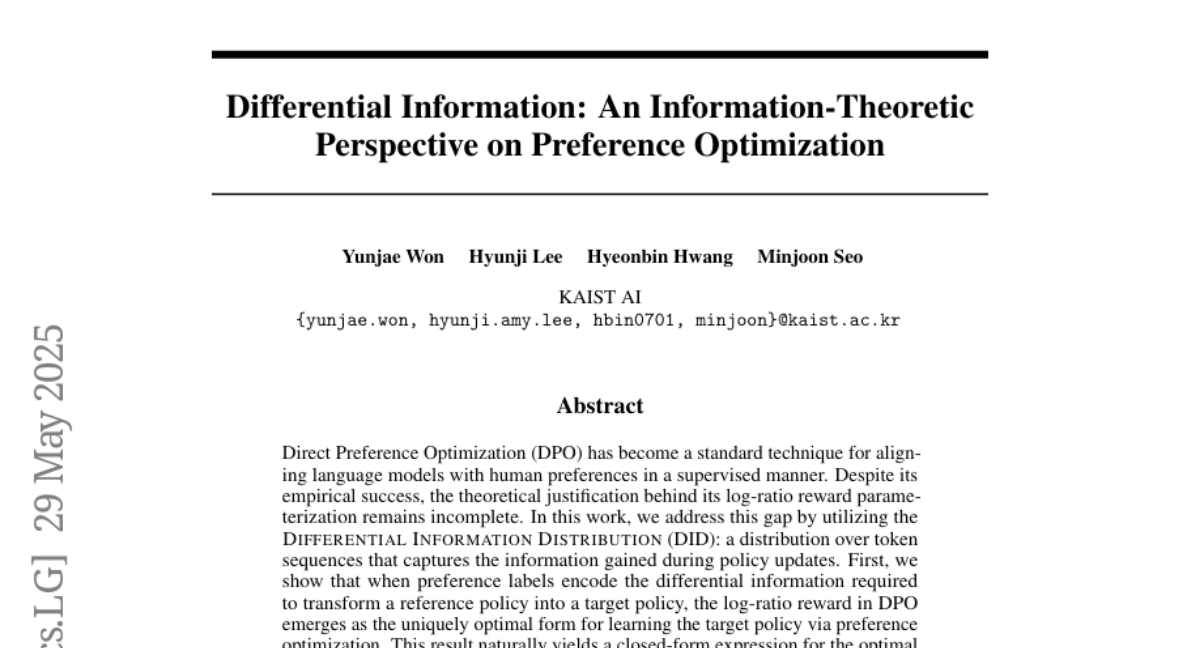
Abstract
Theoretical analysis of Direct Preference Optimization (DPO) reveals that log-ratio reward parameterization is optimal for learning target policy via preference optimization, linked to log-margin ordered policies, and explains policy reinforcement and smoothing based on differential information entropy.