DiffMoE: Dynamic Token Selection for Scalable Diffusion Transformers
Minglei Shi, Ziyang Yuan, Haotian Yang, Xintao Wang, Mingwu Zheng, Xin Tao, Wenliang Zhao, Wenzhao Zheng, Jie Zhou, Jiwen Lu, Pengfei Wan, Di Zhang, Kun Gai
2025-03-21
Summary
This paper is about making AI image generators better and more efficient by having them focus on the most important parts of the image.
What's the problem?
AI image generators often process all parts of an image in the same way, even though some parts are more important or complex than others.
What's the solution?
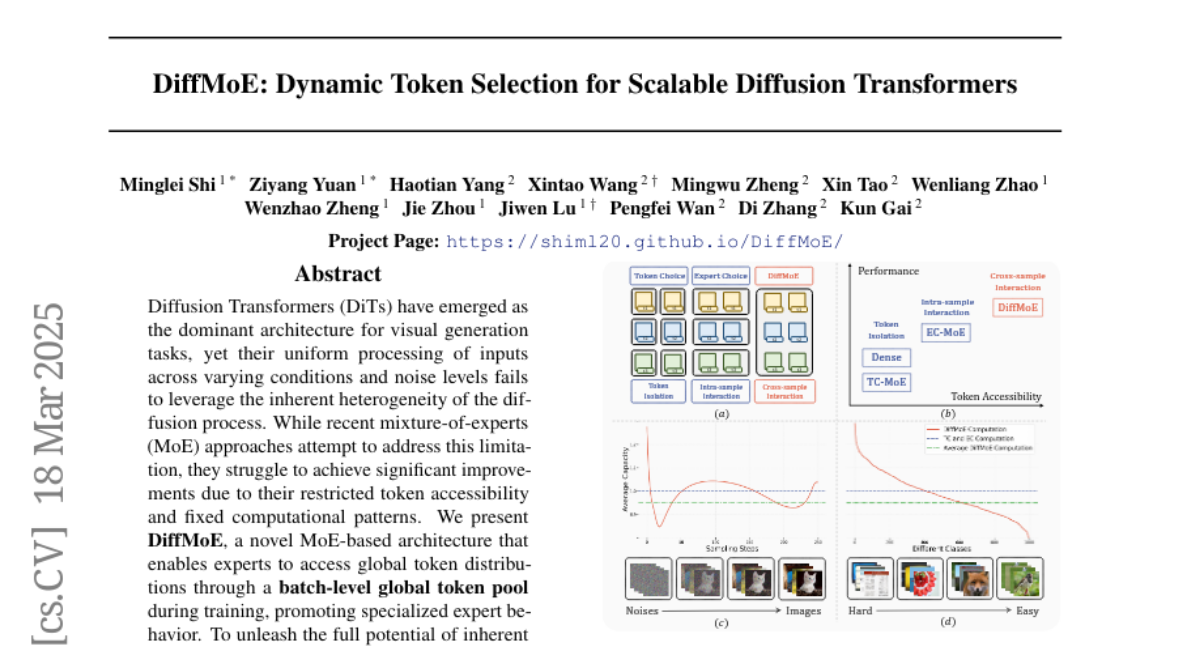
The researchers developed a new method that allows the AI to dynamically select which parts of the image to focus on, based on how noisy or complex they are.
Why it matters?
This work matters because it can lead to AI image generators that are faster, more efficient, and produce higher-quality images.
Abstract
Diffusion models have demonstrated remarkable success in various image generation tasks, but their performance is often limited by the uniform processing of inputs across varying conditions and noise levels. To address this limitation, we propose a novel approach that leverages the inherent heterogeneity of the diffusion process. Our method, DiffMoE, introduces a batch-level global token pool that enables experts to access global token distributions during training, promoting specialized expert behavior. To unleash the full potential of the diffusion process, DiffMoE incorporates a capacity predictor that dynamically allocates computational resources based on noise levels and sample complexity. Through comprehensive evaluation, DiffMoE achieves state-of-the-art performance among diffusion models on ImageNet benchmark, substantially outperforming both dense architectures with 3x activated parameters and existing MoE approaches while maintaining 1x activated parameters. The effectiveness of our approach extends beyond class-conditional generation to more challenging tasks such as text-to-image generation, demonstrating its broad applicability across different diffusion model applications. Project Page: https://shiml20.github.io/DiffMoE/