DiffuCoder: Understanding and Improving Masked Diffusion Models for Code Generation
Shansan Gong, Ruixiang Zhang, Huangjie Zheng, Jiatao Gu, Navdeep Jaitly, Lingpeng Kong, Yizhe Zhang
2025-07-02
Summary
This paper talks about DiffuCoder, a new type of large language model that uses masked diffusion to generate computer code. Unlike traditional models that write code step-by-step, DiffuCoder works by gradually cleaning up a noisy version of the code until it becomes complete and correct.
What's the problem?
The problem is that most code generation models produce code one piece at a time, which can be slower and less flexible. Also, training and decoding methods for diffusion models in coding are not well understood or optimized yet.
What's the solution?
The researchers trained DiffuCoder on a huge amount of code and studied how its denoising process works differently from other models. They introduced a new reinforcement learning method called coupled-GRPO to improve how the model samples and generates code. This approach led to better performance on coding tests and less dependence on traditional step-by-step code generation.
Why it matters?
This matters because DiffuCoder's method allows more flexible and efficient code generation, which can help software developers by producing high-quality code faster and with better editing capabilities.
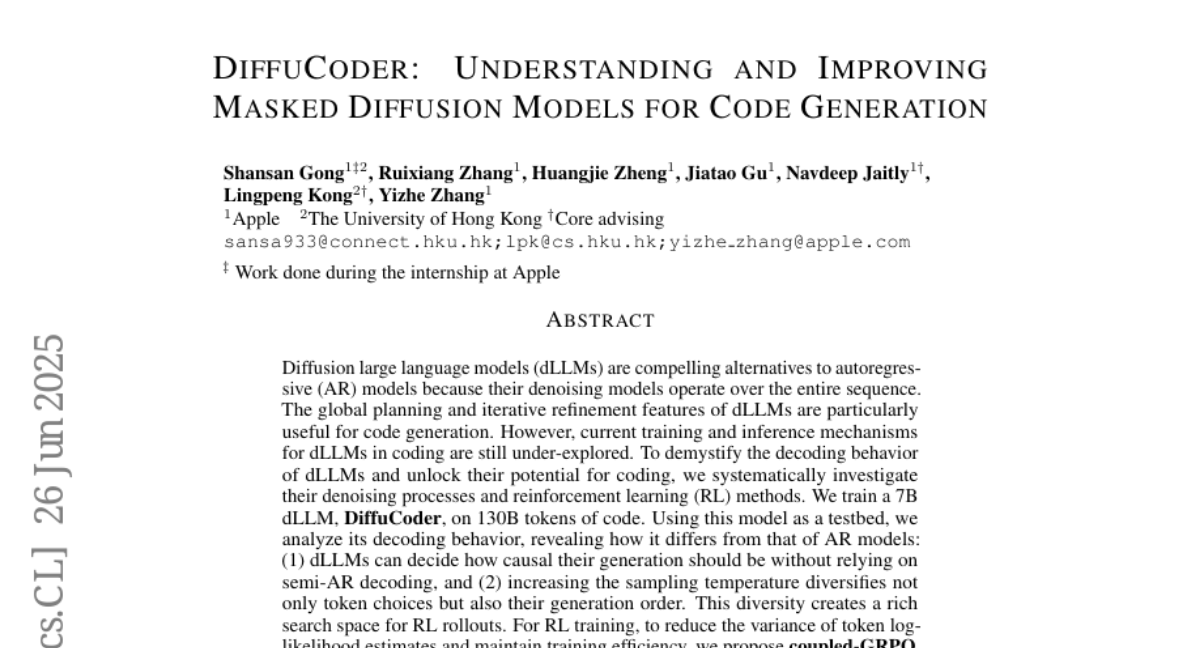
Abstract
Diffusion large language models are applied to code generation, revealing their unique denoising processes and benefiting from a novel reinforcement learning sampling scheme.