DiffuMural: Restoring Dunhuang Murals with Multi-scale Diffusion
Puyu Han, Jiaju Kang, Yuhang Pan, Erting Pan, Zeyu Zhang, Qunchao Jin, Juntao Jiang, Zhichen Liu, Luqi Gong
2025-04-15
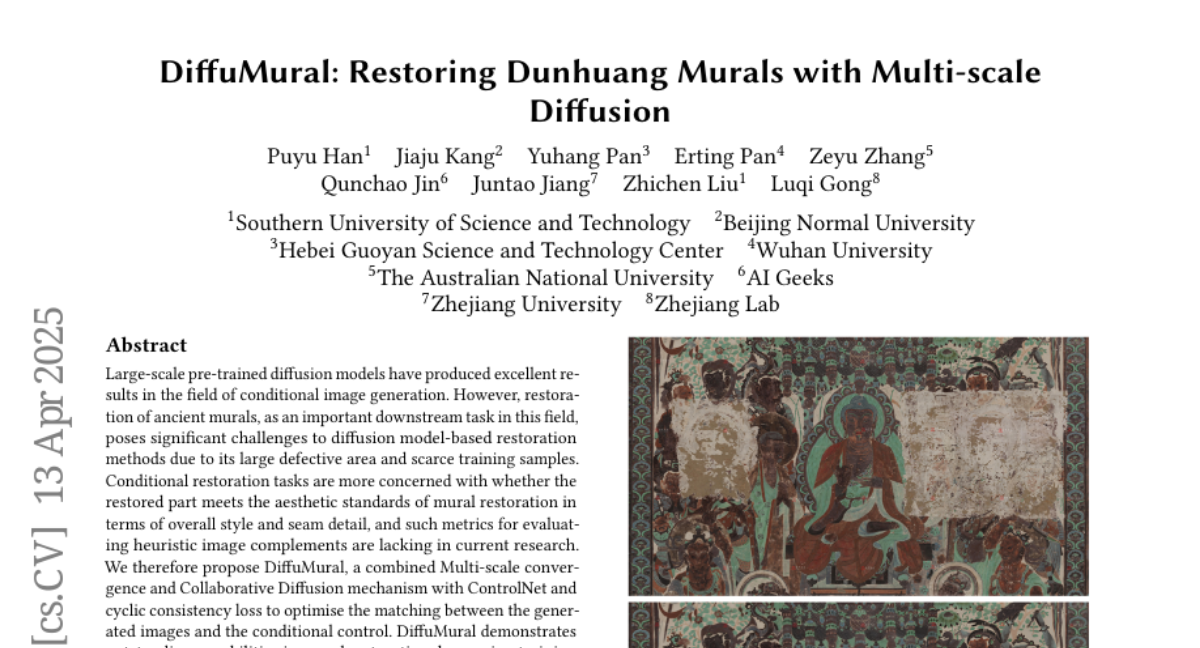
Summary
This paper talks about a new AI method called DiffuMural that helps restore ancient Dunhuang murals by using advanced computer models to fill in missing or damaged parts in a way that matches the original style and details.
What's the problem?
The problem is that many ancient murals, like those in Dunhuang, have large areas that are damaged or missing, and there aren't enough good examples for regular computer models to learn from. Traditional restoration methods are slow, expensive, and sometimes can't keep the artwork's original look, while existing AI methods struggle with making the restored parts look natural and historically accurate.
What's the solution?
The researchers created DiffuMural, which uses a special technique called multi-scale diffusion along with tools like ControlNet and a consistency check to guide the restoration process. They trained this model on a carefully chosen set of murals from the same site to make sure the results fit the original style. The system also uses expert feedback to make sure the restored murals look right and keep their cultural value.
Why it matters?
This work matters because it gives museums and historians a powerful new tool for digitally restoring and preserving important cultural treasures. By making the restoration process faster, more accurate, and respectful of the original art, DiffuMural helps protect human history and makes it easier for people to appreciate and learn from these ancient masterpieces.
Abstract
DiffuMural, a multi-scale diffusion model with ControlNet and cyclic consistency loss, effectively restores ancient murals by addressing large defects and scarce training data, outperforming existing methods.