Diffusion Distillation With Direct Preference Optimization For Efficient 3D LiDAR Scene Completion
An Zhaol, Shengyuan Zhang, Ling Yang, Zejian Li, Jiale Wu, Haoran Xu, AnYang Wei, Perry Pengyun GU Lingyun Sun
2025-04-16
Summary
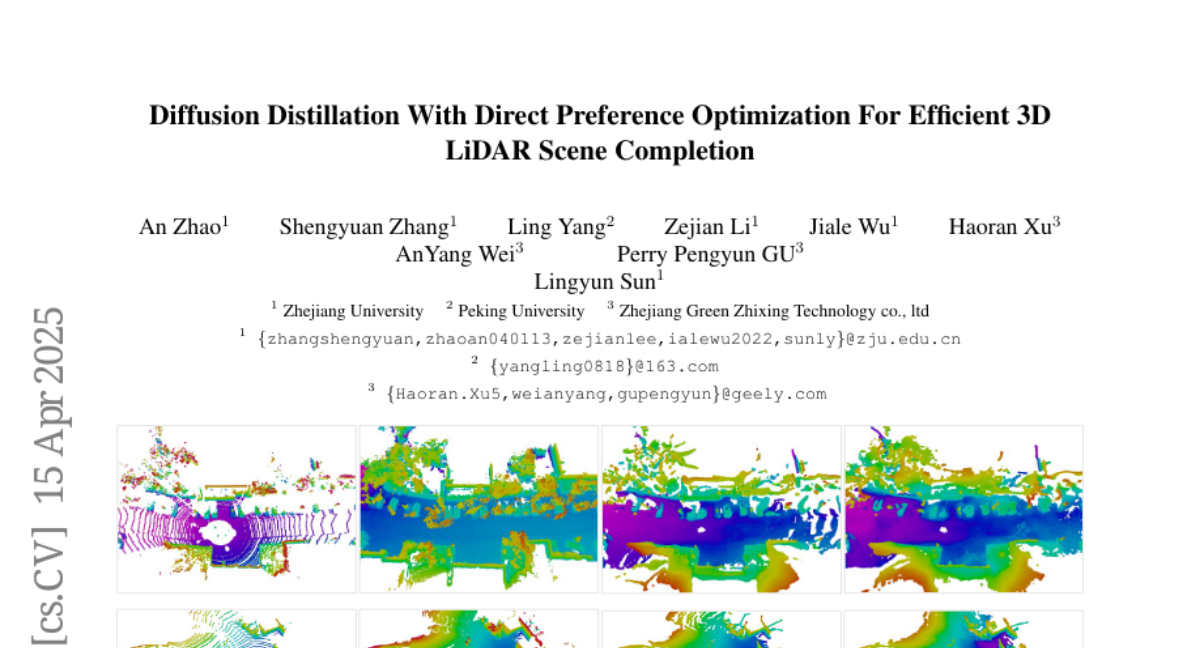
This paper talks about a new method called Distillation-DPO that helps AI systems quickly and accurately fill in missing parts of 3D scenes captured by LiDAR, which is a technology used to scan environments in 3D.
What's the problem?
The problem is that 3D LiDAR scans often have gaps or missing information because the sensors can't see everything perfectly. Filling in these gaps so the whole scene makes sense is difficult and usually takes a lot of time and computer power.
What's the solution?
The researchers combined two techniques: score distillation, which helps the AI learn from the best examples, and preference learning, which teaches the AI to prefer higher-quality completions. By putting these together, Distillation-DPO makes the process of completing 3D scenes both faster and more accurate.
Why it matters?
This matters because it makes technologies like self-driving cars, robotics, and virtual reality safer and more reliable. Faster and better 3D scene completion means these systems can understand and react to the world around them more effectively.
Abstract
Distillation-DPO accelerates 3D LiDAR scene completion by integrating score distillation with preference learning, achieving higher quality and faster completion.