DIP: Unsupervised Dense In-Context Post-training of Visual Representations
Sophia Sirko-Galouchenko, Spyros Gidaris, Antonin Vobecky, Andrei Bursuc, Nicolas Thome
2025-06-24
Summary
This paper talks about DIP, a new method that improves how AI systems understand images by training them after they already learned basic features, without needing labeled data.
What's the problem?
The problem is that vision models often struggle to recognize detailed parts of scenes accurately in different contexts, especially when they haven't been trained on many labeled examples.
What's the solution?
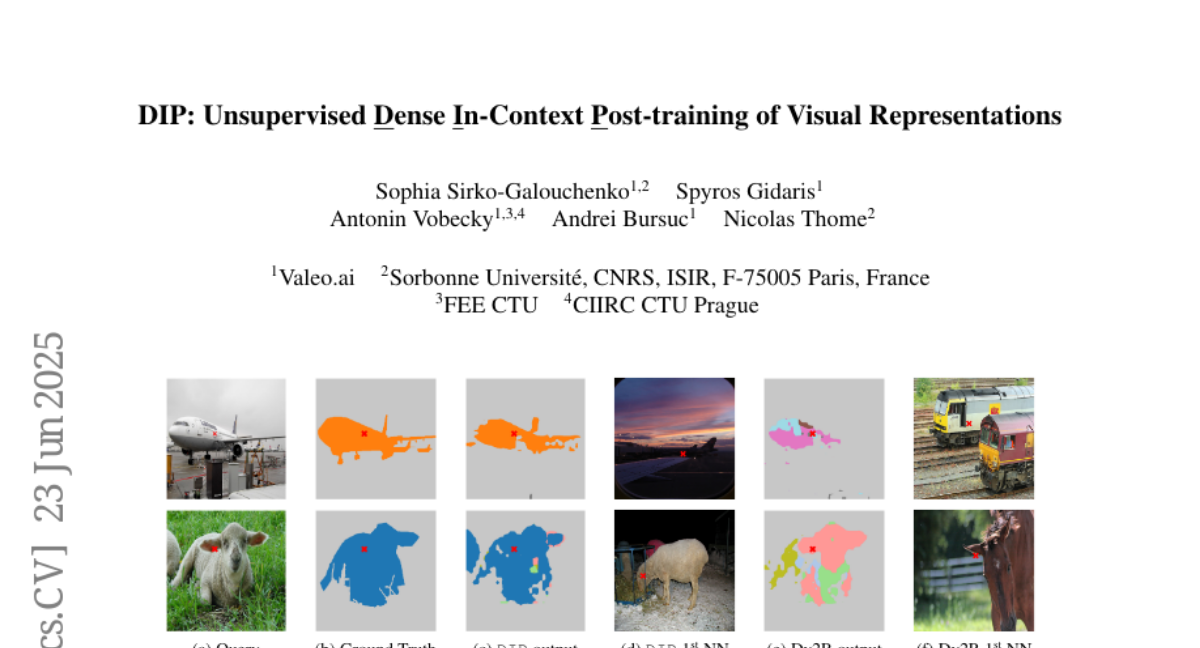
The researchers developed an unsupervised post-training technique that creates fake tasks mimicking real situations by combining a pretrained image model with a diffusion model. This method helps the AI learn better dense image features that capture details and context, improving its understanding of complex scenes.
Why it matters?
This matters because it makes AI better at interpreting images with fewer labeled examples, speeding up and lowering the cost of developing smarter vision systems that can be applied in many real-world situations.
Abstract
A novel unsupervised post-training method improves dense image representations using pseudo-tasks and a pretrained diffusion model for in-context scene understanding.