DreamID: High-Fidelity and Fast diffusion-based Face Swapping via Triplet ID Group Learning
Fulong Ye, Miao Hua, Pengze Zhang, Xinghui Li, Qichao Sun, Songtao Zhao, Qian He, Xinglong Wu
2025-04-24
Summary
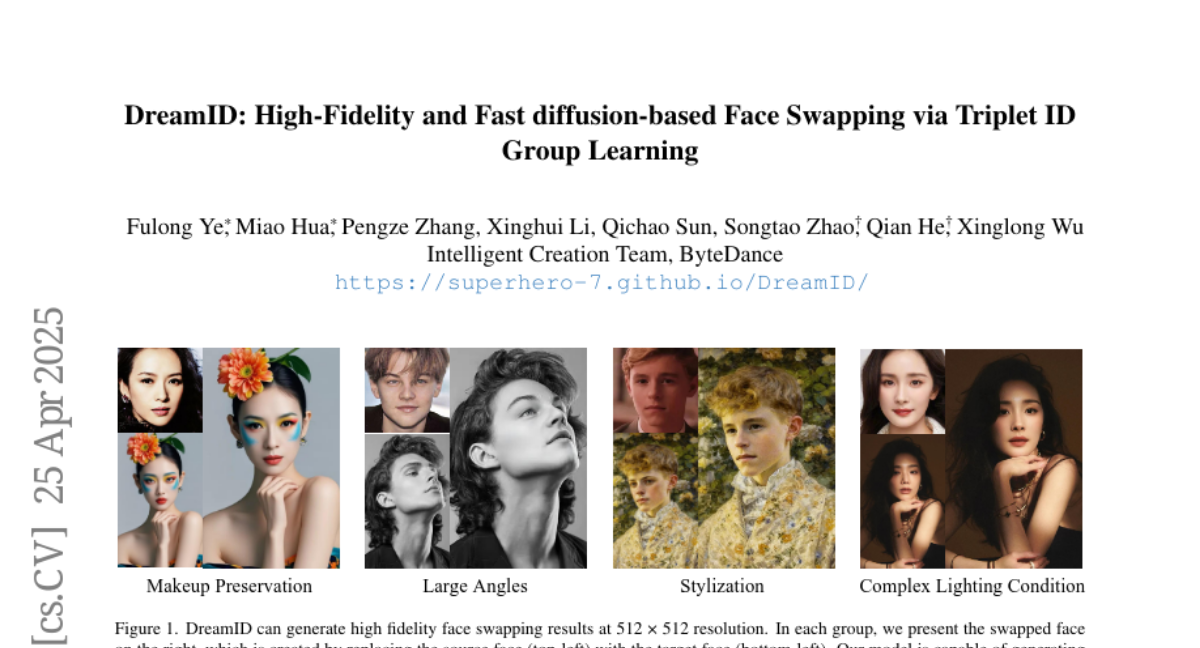
This paper talks about DreamID, a new AI model that swaps faces in photos using a method called diffusion, making the swapped faces look very realistic and keeping important features like facial expressions, lighting, and even things like glasses.
What's the problem?
The problem is that most face swapping models either take a long time to make a single image, or they don't do a great job of making the new face look like the original person while also matching things like pose, expression, and other small details. They often rely on training methods that aren't direct enough, which leads to less accurate results.
What's the solution?
DreamID solves this by creating a special training setup called Triplet ID Group Learning, where the model is given three images to learn from: two of the same person and one of a different person. By swapping faces in a controlled way and using these groups, the model learns exactly how to keep the right identity and details. DreamID also uses a faster version of the diffusion process, so it can create high-quality images much quicker than before. Its architecture includes parts that focus on both the tiny details and the overall look of the face, making the swaps more natural and accurate.
Why it matters?
This matters because DreamID sets a new standard for face swapping, making it possible to get both fast and highly realistic results. This can help with things like movies, social media, and privacy, and it also shows how better training and smarter AI design can solve tough problems in image editing.
Abstract
A diffusion-based face swapping model, DreamID, achieves high identity similarity, attribute preservation, and fast inference by using explicit Triplet ID Group supervision and an improved diffusion architecture.