DreamRenderer: Taming Multi-Instance Attribute Control in Large-Scale Text-to-Image Models
Dewei Zhou, Mingwei Li, Zongxin Yang, Yi Yang
2025-03-18
Summary
This is a collection of research paper titles related to recent advances and challenges in AI, spanning areas like image and video generation, language models, robotics, and more.
What's the problem?
The problems addressed include improving the efficiency and quality of AI-generated content, enhancing the reasoning abilities of AI models, mitigating biases and safety risks, and enabling AI to better interact with the real world.
What's the solution?
The solutions involve developing new models, training techniques, benchmarks, and evaluation methods. These include innovations in diffusion models, transformers, reinforcement learning, and multimodal learning. Specific solutions focus on improving image compression (PerCoV2), generating consistent videos (CINEMA, Long Context Tuning), enabling robots to navigate and manipulate objects (UniGoal, adversarial data collection), and mitigating toxicity in online discussions (Silent Is Not Actually Silent).
Why it matters?
These advancements are important because they push the boundaries of AI capabilities, making AI more powerful, reliable, and beneficial for various applications. They also address critical challenges related to safety, fairness, and transparency, ensuring that AI is developed and deployed responsibly.
Abstract
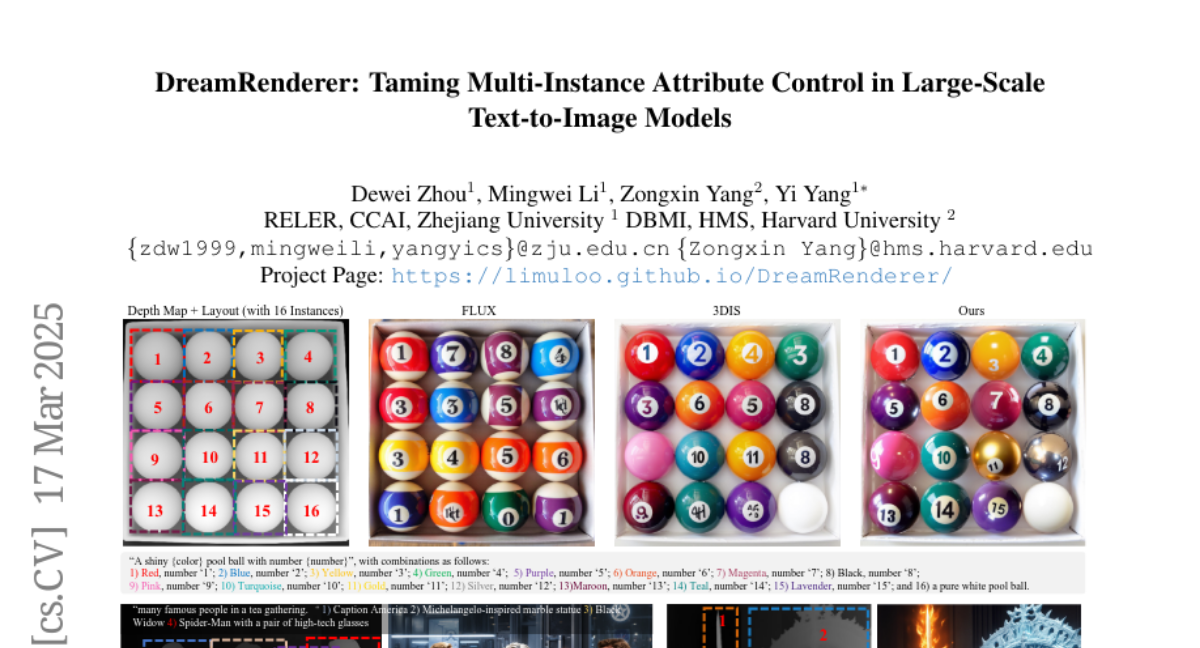
Image-conditioned generation methods, such as depth- and canny-conditioned approaches, have demonstrated remarkable abilities for precise image synthesis. However, existing models still struggle to accurately control the content of multiple instances (or regions). Even state-of-the-art models like FLUX and 3DIS face challenges, such as attribute leakage between instances, which limits user control. To address these issues, we introduce DreamRenderer, a training-free approach built upon the FLUX model. DreamRenderer enables users to control the content of each instance via bounding boxes or masks, while ensuring overall visual harmony. We propose two key innovations: 1) Bridge Image Tokens for Hard Text Attribute Binding, which uses replicated image tokens as bridge tokens to ensure that T5 text embeddings, pre-trained solely on text data, bind the correct visual attributes for each instance during Joint Attention; 2) Hard Image Attribute Binding applied only to vital layers. Through our analysis of FLUX, we identify the critical layers responsible for instance attribute rendering and apply Hard Image Attribute Binding only in these layers, using soft binding in the others. This approach ensures precise control while preserving image quality. Evaluations on the COCO-POS and COCO-MIG benchmarks demonstrate that DreamRenderer improves the Image Success Ratio by 17.7% over FLUX and enhances the performance of layout-to-image models like GLIGEN and 3DIS by up to 26.8%. Project Page: https://limuloo.github.io/DreamRenderer/.