Eliciting Fine-Tuned Transformer Capabilities via Inference-Time Techniques
Asankhaya Sharma
2025-06-15
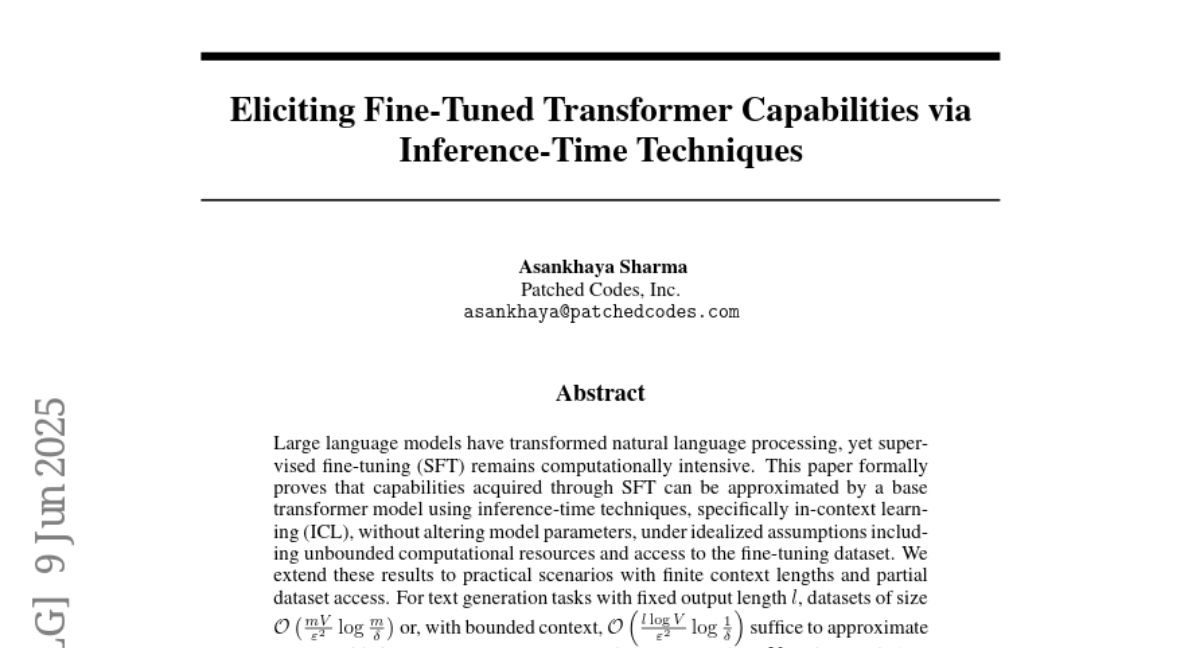
Summary
This paper talks about how transformer models, a type of AI, can do some of the same things as fine-tuning by learning from examples given during use, without changing any of their internal settings. This ability is called in-context learning, and the paper explains it with both math ideas and real techniques.
What's the problem?
The problem is that normally, to get AI models to do better on a specific task, you need to fine-tune them by changing their parameters through extra training, which can take a lot of time and computing power. It's also unclear how well transformers can actually learn new things without changing their internal settings.
What's the solution?
The solution was to show that transformers can imitate fine-tuning by using examples provided during inference time (when the model is asked to perform a task) to learn how to do the task without any parameter updates. The paper supports this with theoretical proofs and practical methods to help the model do this well, essentially teaching the transformer to 'learn how to learn' on the fly.
Why it matters?
This matters because it means AI models can be quickly adapted to new tasks just by showing them examples, without the costly process of training them again. This makes AI more flexible and easier to use in many real-world situations where tasks can change or new tasks appear suddenly.
Abstract
Transformers can approximate supervised fine-tuning capabilities through in-context learning without altering model parameters, supported by theoretical bounds and practical techniques.