EMLoC: Emulator-based Memory-efficient Fine-tuning with LoRA Correction
Hsi-Che Lin, Yu-Chu Yu, Kai-Po Chang, Yu-Chiang Frank Wang
2025-06-18
Summary
This paper talks about EMLoC, a method that lets people fine-tune large AI models using much less computer memory by creating a smaller version of the model called an emulator and making fixes during training to match the original model.
What's the problem?
The problem is that fine-tuning big AI models usually needs a lot more memory than what is needed just to run them, which makes it hard for most people without expensive hardware to customize these models.
What's the solution?
The researchers built EMLoC to make a lightweight emulator of the large model by compressing parts of it based on how it reacts to specific data. They then fine-tune this emulator using an efficient technique called LoRA. To fix differences between the emulator and the full model, they invented a correction method that adjusts the fine-tuned parts so they work well on the original model during use.
Why it matters?
This matters because it allows more people to adapt powerful AI models for their own purposes without needing expensive equipment, making personalized and specialized AI more accessible to everyone.
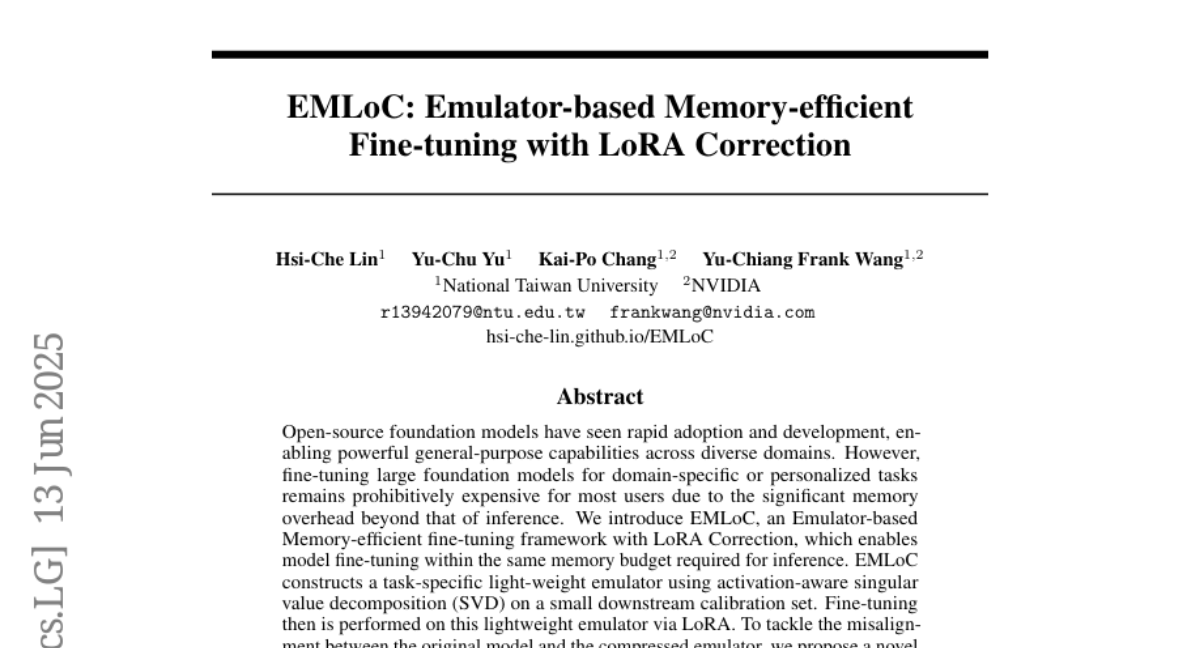
Abstract
EMLoC, an memory-efficient fine-tuning framework using activation-aware SVD and LoRA, allows model adaptation within inference memory constraints for diverse applications.