Enabling Flexible Multi-LLM Integration for Scalable Knowledge Aggregation
Zhenglun Kong, Zheng Zhan, Shiyue Hou, Yifan Gong, Xin Meng, Pengwei Sui, Peiyan Dong, Xuan Shen, Zifeng Wang, Pu Zhao, Hao Tang, Stratis Ioannidis, Yanzhi Wang
2025-06-02
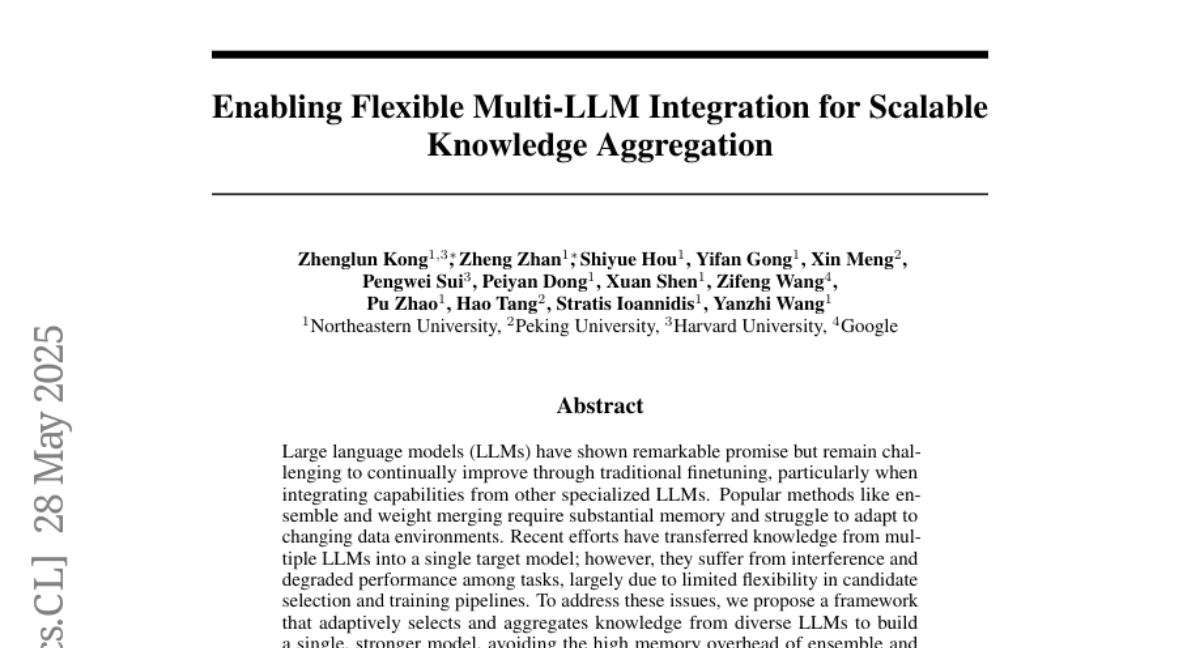
Summary
This paper talks about a new framework that lets different large language models work together more smoothly, so their combined knowledge can be used in a smarter and more flexible way.
What's the problem?
The problem is that when you try to combine information from several language models, they can sometimes interfere with each other or make things more complicated, which limits how much knowledge you can actually use and makes it harder to scale up.
What's the solution?
The researchers developed a system that can adaptively choose which language model to use for each situation and then blend their answers together using dynamic weights, so the best parts of each model are used while reducing any confusion or overlap.
Why it matters?
This is important because it allows for much bigger and more reliable AI systems that can pull together knowledge from many sources, making them more powerful for research, business, and everyday problem-solving.
Abstract
A framework for adaptive selection and dynamic weighted fusion of knowledge from multiple LLMs reduces interference and improves scalability in knowledge aggregation.