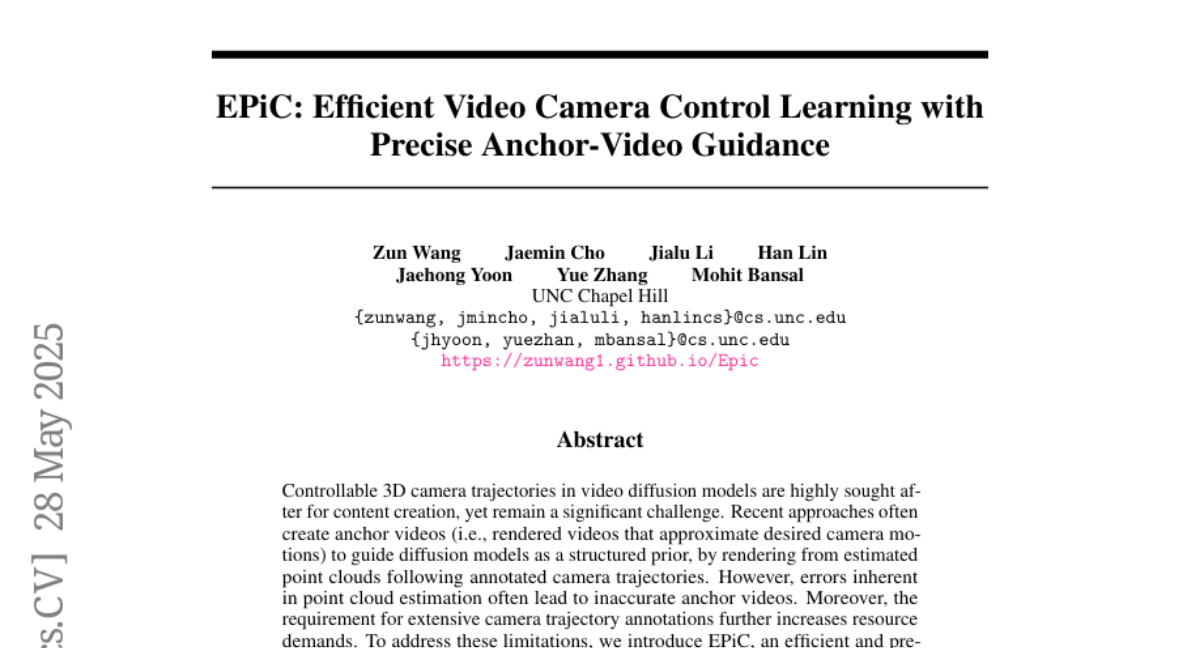
EPiC: Efficient Video Camera Control Learning with Precise Anchor-Video Guidance
Zun Wang, Jaemin Cho, Jialu Li, Han Lin, Jaehong Yoon, Yue Zhang, Mohit Bansal
2025-05-29
Summary
This paper talks about EPiC, a new method that helps AI models control virtual cameras in 3D video creation more efficiently and accurately. The system is designed to make it easier for computers to generate videos where the camera moves smoothly and focuses on the right parts of a scene.
What's the problem?
The problem is that creating realistic and well-controlled camera movements in computer-generated videos is very challenging, especially when you want the camera to follow specific actions or focus points. Traditional methods often require a lot of computer power and are not very precise, which can lead to awkward or unrealistic video results.
What's the solution?
The researchers built a framework that uses something called first-frame visibility masking to create high-quality 'anchor' videos, which serve as guides for the camera. They then use a special lightweight module called ControlNet to help the AI follow these guides while using much less computing power than before. This approach allows the system to create videos with smooth and accurate camera movements even when resources are limited.
Why it matters?
This is important because it makes advanced video creation tools more accessible and efficient, allowing for better quality videos in things like animation, gaming, and virtual reality. It means that even with less powerful computers, people can still make impressive videos with professional-looking camera work.
Abstract
EPiC is a framework for efficient 3D camera control in video diffusion models that constructs high-quality anchor videos through first-frame visibility masking, integrates them using a lightweight ControlNet module, and achieves state-of-the-art performance on I2V tasks with minimal resources.