Exploring the Evolution of Physics Cognition in Video Generation: A Survey
Minghui Lin, Xiang Wang, Yishan Wang, Shu Wang, Fengqi Dai, Pengxiang Ding, Cunxiang Wang, Zhengrong Zuo, Nong Sang, Siteng Huang, Donglin Wang
2025-03-28
Summary
This paper looks at how AI video generation is improving in its ability to understand and follow the laws of physics.
What's the problem?
AI-generated videos often look unrealistic because they don't obey the basic rules of physics.
What's the solution?
This survey examines how researchers are trying to teach AI to understand physics, using techniques like motion representation and physical knowledge.
Why it matters?
This work matters because it's a step toward creating AI that can generate videos that are not only visually appealing but also physically plausible, which is important for applications like simulations and virtual reality.
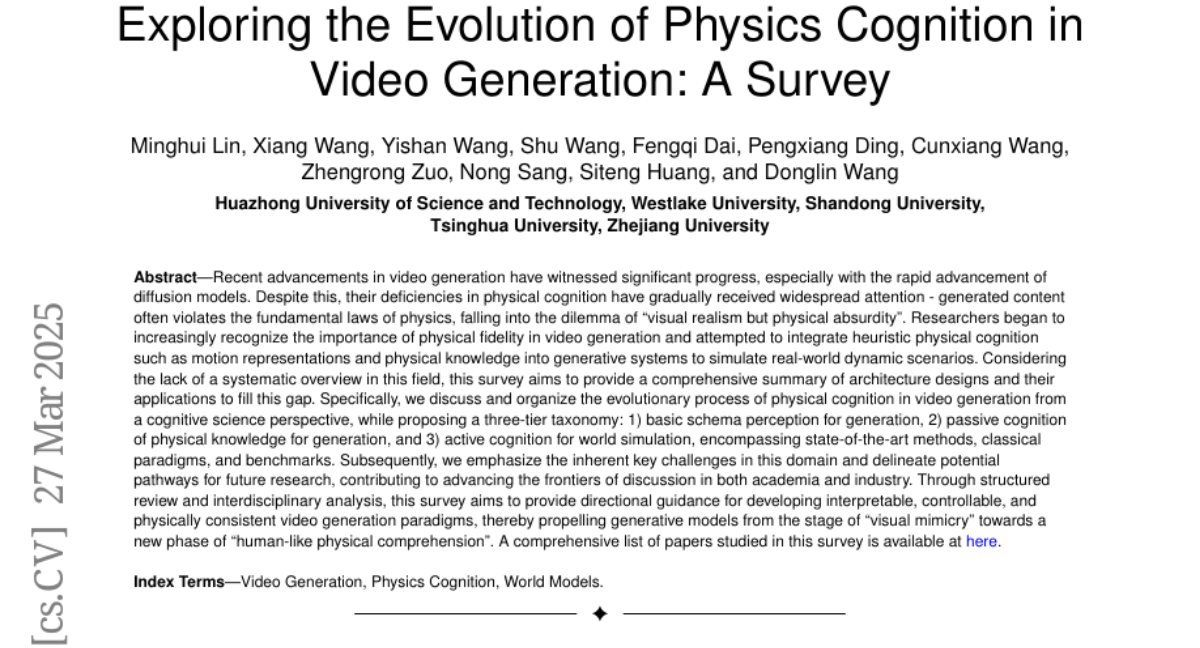
Abstract
Recent advancements in video generation have witnessed significant progress, especially with the rapid advancement of diffusion models. Despite this, their deficiencies in physical cognition have gradually received widespread attention - generated content often violates the fundamental laws of physics, falling into the dilemma of ''visual realism but physical absurdity". Researchers began to increasingly recognize the importance of physical fidelity in video generation and attempted to integrate heuristic physical cognition such as motion representations and physical knowledge into generative systems to simulate real-world dynamic scenarios. Considering the lack of a systematic overview in this field, this survey aims to provide a comprehensive summary of architecture designs and their applications to fill this gap. Specifically, we discuss and organize the evolutionary process of physical cognition in video generation from a cognitive science perspective, while proposing a three-tier taxonomy: 1) basic schema perception for generation, 2) passive cognition of physical knowledge for generation, and 3) active cognition for world simulation, encompassing state-of-the-art methods, classical paradigms, and benchmarks. Subsequently, we emphasize the inherent key challenges in this domain and delineate potential pathways for future research, contributing to advancing the frontiers of discussion in both academia and industry. Through structured review and interdisciplinary analysis, this survey aims to provide directional guidance for developing interpretable, controllable, and physically consistent video generation paradigms, thereby propelling generative models from the stage of ''visual mimicry'' towards a new phase of ''human-like physical comprehension''.