FFaceNeRF: Few-shot Face Editing in Neural Radiance Fields
Kwan Yun, Chaelin Kim, Hangyeul Shin, Junyong Noh
2025-03-24
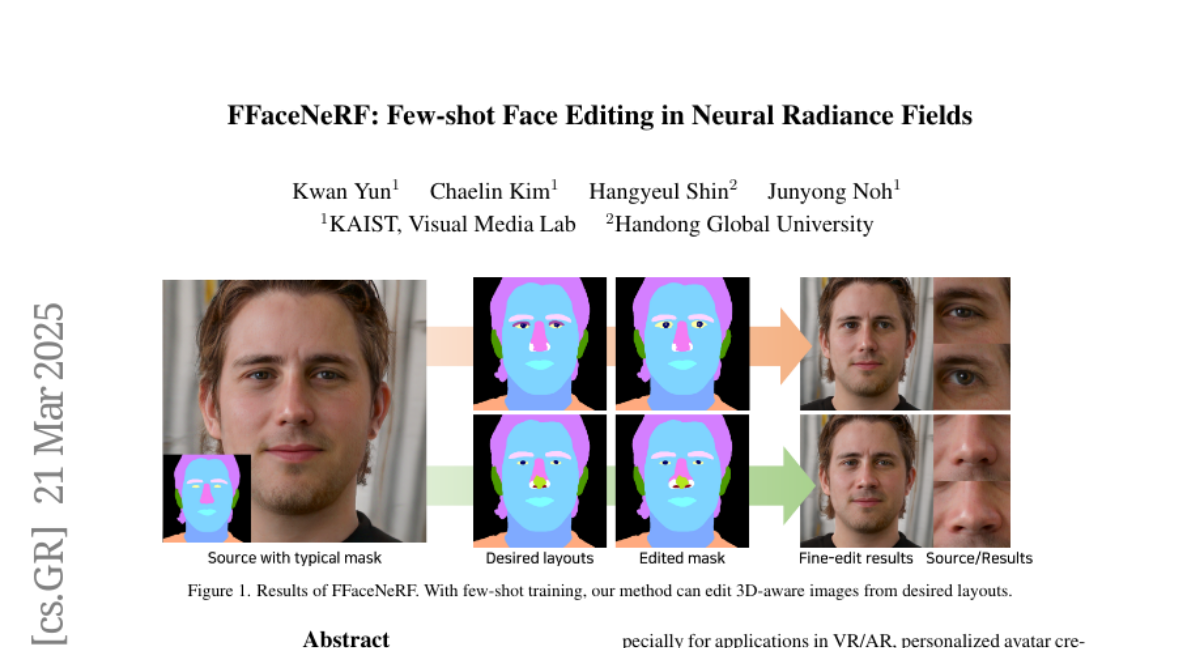
Summary
This paper is about making it easier to edit 3D models of faces using AI, even if you only have a few example images.
What's the problem?
Existing methods for editing 3D faces require a lot of training data and don't give users much control over the edits.
What's the solution?
The researchers developed a new method called FFaceNeRF that uses a geometry adapter and latent mixing to allow for more flexible and controlled editing with only a few examples.
Why it matters?
This work matters because it can make 3D face editing more accessible and customizable for applications like personalized medical imaging or creative face editing.
Abstract
Recent 3D face editing methods using masks have produced high-quality edited images by leveraging Neural Radiance Fields (NeRF). Despite their impressive performance, existing methods often provide limited user control due to the use of pre-trained segmentation masks. To utilize masks with a desired layout, an extensive training dataset is required, which is challenging to gather. We present FFaceNeRF, a NeRF-based face editing technique that can overcome the challenge of limited user control due to the use of fixed mask layouts. Our method employs a geometry adapter with feature injection, allowing for effective manipulation of geometry attributes. Additionally, we adopt latent mixing for tri-plane augmentation, which enables training with a few samples. This facilitates rapid model adaptation to desired mask layouts, crucial for applications in fields like personalized medical imaging or creative face editing. Our comparative evaluations demonstrate that FFaceNeRF surpasses existing mask based face editing methods in terms of flexibility, control, and generated image quality, paving the way for future advancements in customized and high-fidelity 3D face editing. The code is available on the {https://kwanyun.github.io/FFaceNeRF_page/{project-page}}.