FinePhys: Fine-grained Human Action Generation by Explicitly Incorporating Physical Laws for Effective Skeletal Guidance
Dian Shao, Mingfei Shi, Shengda Xu, Haodong Chen, Yongle Huang, Binglu Wang
2025-05-20
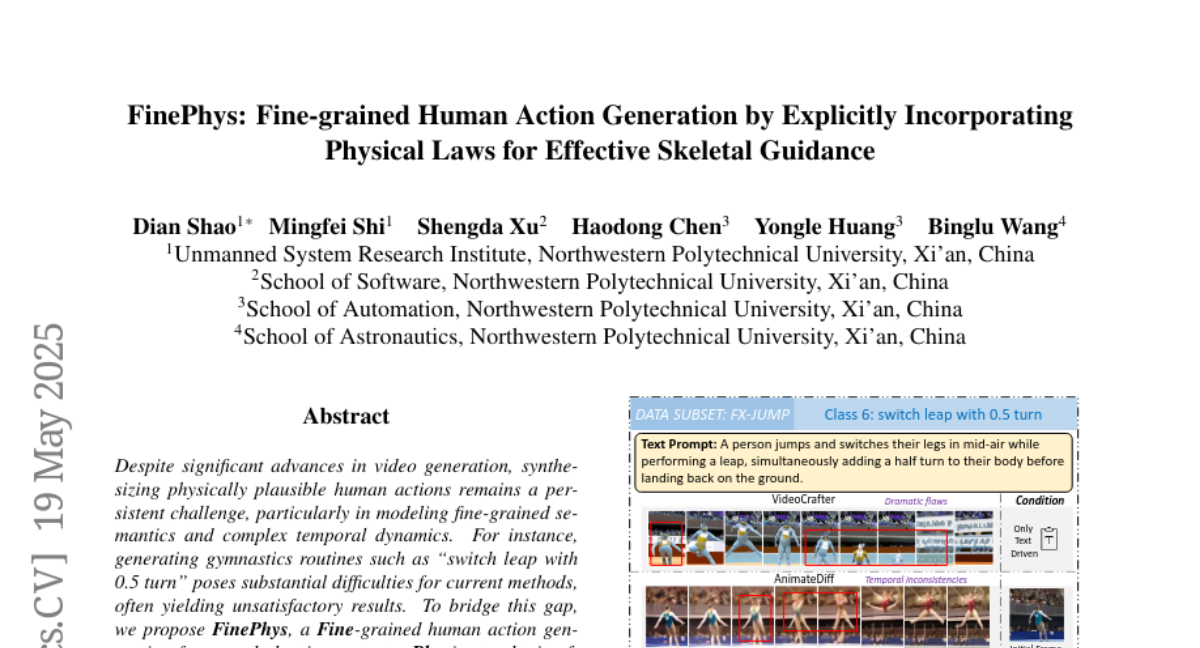
Summary
This paper talks about FinePhys, a new system that uses the rules of physics to help AI create much more realistic human movements and actions in animations or simulations.
What's the problem?
The problem is that when AI tries to generate human actions, the movements often look unnatural or fake because the models don't always take real-world physics into account, especially when it comes to small, detailed motions.
What's the solution?
To fix this, the researchers built a framework that combines deep learning with actual physics laws, using special math (Euler-Lagrange equations) to guide how the AI creates and refines human poses and movements from 2D images into realistic 3D actions.
Why it matters?
This matters because it means digital characters in games, movies, or virtual reality can move in ways that look much more natural and believable, making these experiences more engaging and lifelike.
Abstract
FinePhys is a framework that integrates physics principles into deep learning for generating realistic human actions by combining 2D-to-3D pose estimation with Euler-Lagrange-based motion re-estimation, significantly improving the quality of fine-grained action synthesis.