FlexIP: Dynamic Control of Preservation and Personality for Customized Image Generation
Linyan Huang, Haonan Lin, Yanning Zhou, Kaiwen Xiao
2025-04-14
Summary
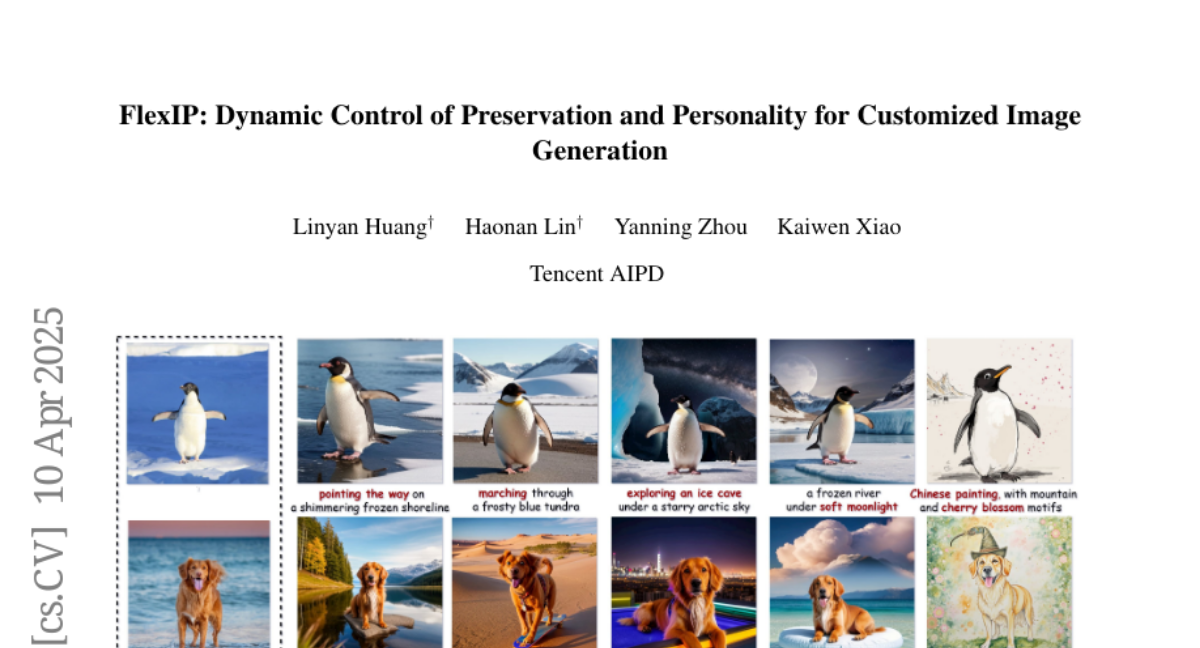
This paper talks about FlexIP, a new framework for AI image generation that gives users more control over how much an image keeps someone's identity versus how much it can be changed with different styles or edits. FlexIP makes it possible to adjust these two things separately, so you can get both realistic and creative results without sacrificing one for the other.
What's the problem?
The problem is that most current image generation models have a hard time balancing between keeping a person's identity clear and allowing for creative or personalized changes. If you try to make the image look more like the original person, you lose flexibility in editing, and if you focus on editing, you often lose important identity details. This trade-off limits how useful and fun AI image editing can be.
What's the solution?
FlexIP solves this by splitting the job into two parts: one adapter is focused on preserving identity, while another handles the style and personalization. These two adapters work together inside the AI model, and a special dynamic weight gating system lets you decide how much you want to focus on identity or creativity for each image. This means you can smoothly adjust the balance between looking like the original and making creative edits, instead of being stuck with just one or the other.
Why it matters?
This work matters because it makes AI image generation much more flexible and powerful. Artists, designers, and everyday users can now create images that stay true to someone's identity while also exploring different looks, styles, or even turning people into characters, all without losing quality. FlexIP opens up new possibilities for personalized content, entertainment, and digital creativity.
Abstract
FlexIP framework decouples identity preservation and stylistic manipulation in 2D generative models through dedicated adapters, enhancing flexibility and performance.