FLEXITOKENS: Flexible Tokenization for Evolving Language Models
Abraham Toluase Owodunni, Orevaoghene Ahia, Sachin Kumar
2025-07-18
Summary
This paper talks about FLEXITOKENS, a new approach that makes language models more flexible in how they break down text into tokens, allowing the tokenizer to adapt and learn the best way to split text for different languages and content types.
What's the problem?
The problem is that traditional tokenizers are fixed and rigid, which can cause inefficient splitting of words, especially for new or uncommon languages and varied types of text, leading to poorer model performance.
What's the solution?
The authors designed a byte-level language model with a learnable tokenizer that predicts where token boundaries should be based on the input itself, allowing variable-length tokens and reducing over-fragmentation, which improves the model’s understanding and performance across many languages and tasks.
Why it matters?
This matters because more adaptable tokenization helps language models work better with diverse languages and types of text, making them more effective and accurate in understanding and generating text in different real-world situations.
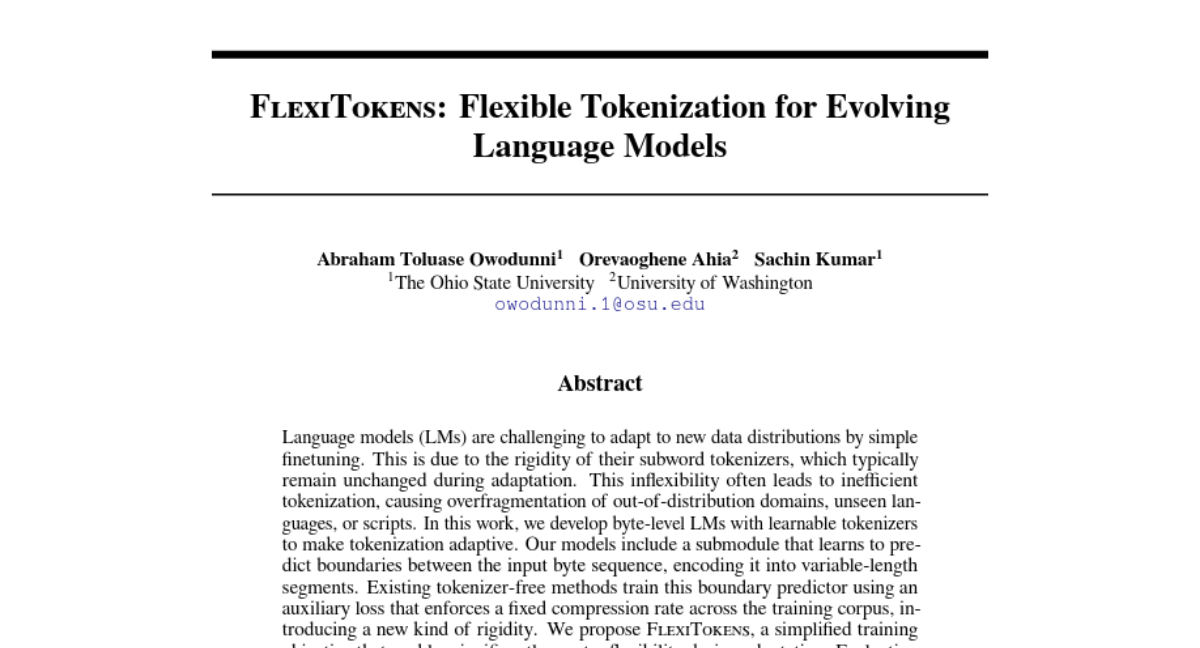
Abstract
FLEXITOKENS, a byte-level language model with a learnable tokenizer, reduces token over-fragmentation and improves performance across multilingual and morphologically diverse tasks.