From Bytes to Ideas: Language Modeling with Autoregressive U-Nets
Mathurin Videau, Badr Youbi Idrissi, Alessandro Leite, Marc Schoenauer, Olivier Teytaud, David Lopez-Paz
2025-06-18
Summary
This paper talks about using an autoregressive U-Net, a special kind of AI model designed for language tasks. Instead of breaking text into fixed pieces beforehand, the model learns to group its own pieces while it trains. It reads raw bytes and then pools them into words and groups of words, allowing it to understand language at multiple levels.
What's the problem?
The problem is that most language models rely on fixed tokenization methods that split text into pre-set chunks, which limits the model’s flexibility and how far it can predict into the future. This fixed way can struggle with character-level tasks and languages with less training data.
What's the solution?
The researchers introduced an autoregressive U-Net that processes text in a hierarchical way, predicting parts of text at different scales. By training the model to embed its own tokens dynamically, it can work better with fine details and broad meanings, improving performance especially on tasks involving small text units and low-resource languages.
Why it matters?
This matters because it makes language models more flexible and powerful, allowing them to better understand and predict text in many languages and situations, including those with limited data or that require detailed character-level understanding.
Abstract
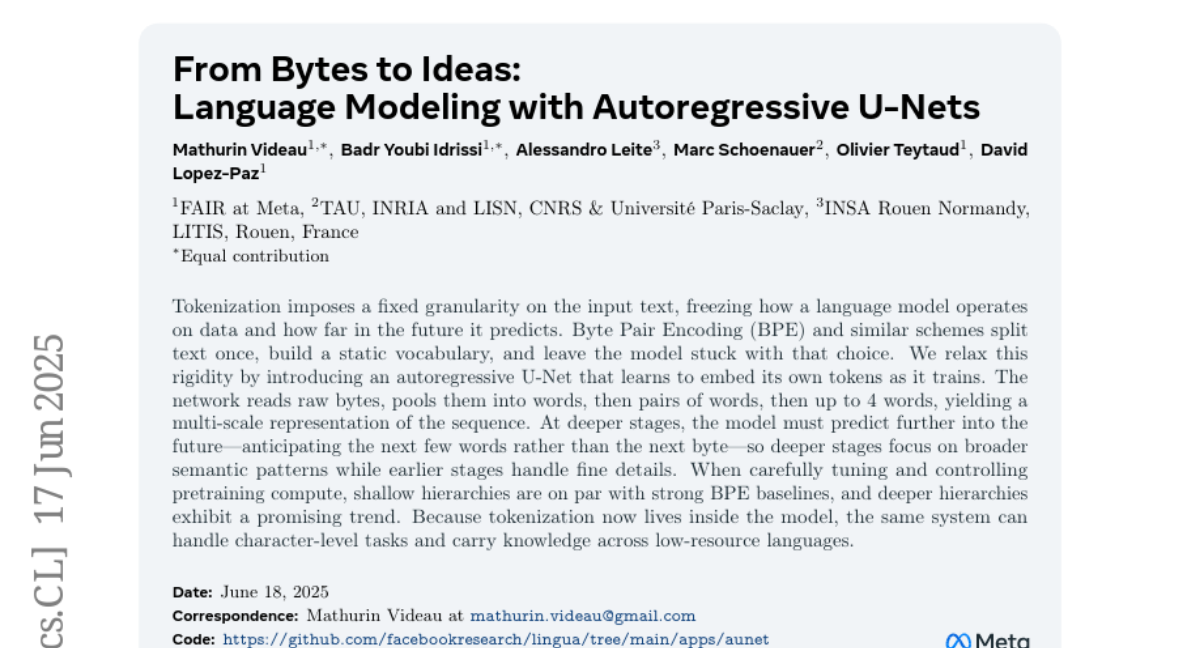
An autoregressive U-Net learns to embed its own tokens during training, enabling a multi-scale view of text sequences and improved handling of character-level tasks and low-resource languages.