GaussianProperty: Integrating Physical Properties to 3D Gaussians with LMMs
Xinli Xu, Wenhang Ge, Dicong Qiu, ZhiFei Chen, Dongyu Yan, Zhuoyun Liu, Haoyu Zhao, Hanfeng Zhao, Shunsi Zhang, Junwei Liang, Ying-Cong Chen
2024-12-17
Summary
This paper introduces GaussianProperty, a new framework that assigns physical properties to 3D Gaussian representations to improve how we understand and simulate objects in computer graphics, robotics, and augmented reality.
What's the problem?
Estimating physical properties of visual data is important for applications like augmented reality and robotics, but it is challenging due to ambiguities and complexities in how these properties are determined. Existing methods often struggle to accurately assign these properties to 3D models, leading to difficulties in simulating realistic interactions with objects.
What's the solution?
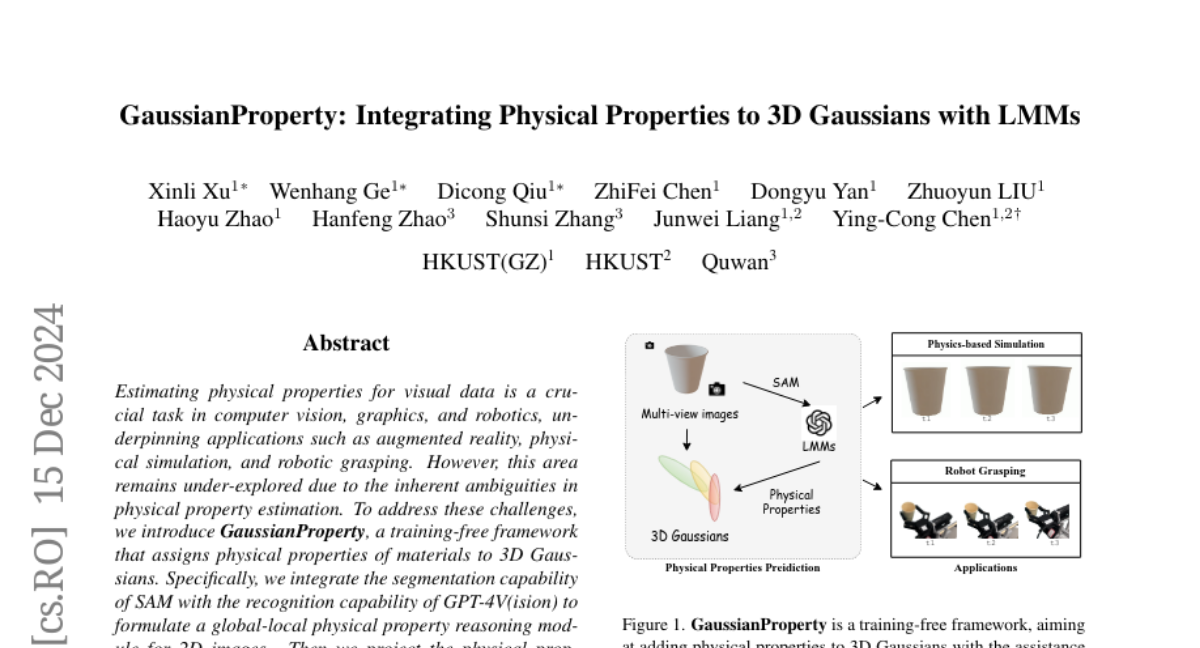
GaussianProperty offers a training-free approach that combines the segmentation abilities of a model called SAM with the recognition capabilities of GPT-4V(ision). This allows the framework to analyze 2D images and project the physical properties onto 3D Gaussian models using a voting strategy. The system can then be used for physics-based simulations and robotic grasping, predicting the forces needed for safe object handling based on the estimated physical properties.
Why it matters?
This work is significant because it enhances how we can simulate physical interactions in digital environments, making it easier to create realistic animations and improve robotic systems. By accurately integrating physical properties into 3D models, it opens up new possibilities for applications in various fields, including gaming, virtual reality, and robotics.
Abstract
Estimating physical properties for visual data is a crucial task in computer vision, graphics, and robotics, underpinning applications such as augmented reality, physical simulation, and robotic grasping. However, this area remains under-explored due to the inherent ambiguities in physical property estimation. To address these challenges, we introduce GaussianProperty, a training-free framework that assigns physical properties of materials to 3D Gaussians. Specifically, we integrate the segmentation capability of SAM with the recognition capability of GPT-4V(ision) to formulate a global-local physical property reasoning module for 2D images. Then we project the physical properties from multi-view 2D images to 3D Gaussians using a voting strategy. We demonstrate that 3D Gaussians with physical property annotations enable applications in physics-based dynamic simulation and robotic grasping. For physics-based dynamic simulation, we leverage the Material Point Method (MPM) for realistic dynamic simulation. For robot grasping, we develop a grasping force prediction strategy that estimates a safe force range required for object grasping based on the estimated physical properties. Extensive experiments on material segmentation, physics-based dynamic simulation, and robotic grasping validate the effectiveness of our proposed method, highlighting its crucial role in understanding physical properties from visual data. Online demo, code, more cases and annotated datasets are available on https://Gaussian-Property.github.io{this https URL}.