Generating Physically Stable and Buildable LEGO Designs from Text
Ava Pun, Kangle Deng, Ruixuan Liu, Deva Ramanan, Changliu Liu, Jun-Yan Zhu
2025-05-09
Summary
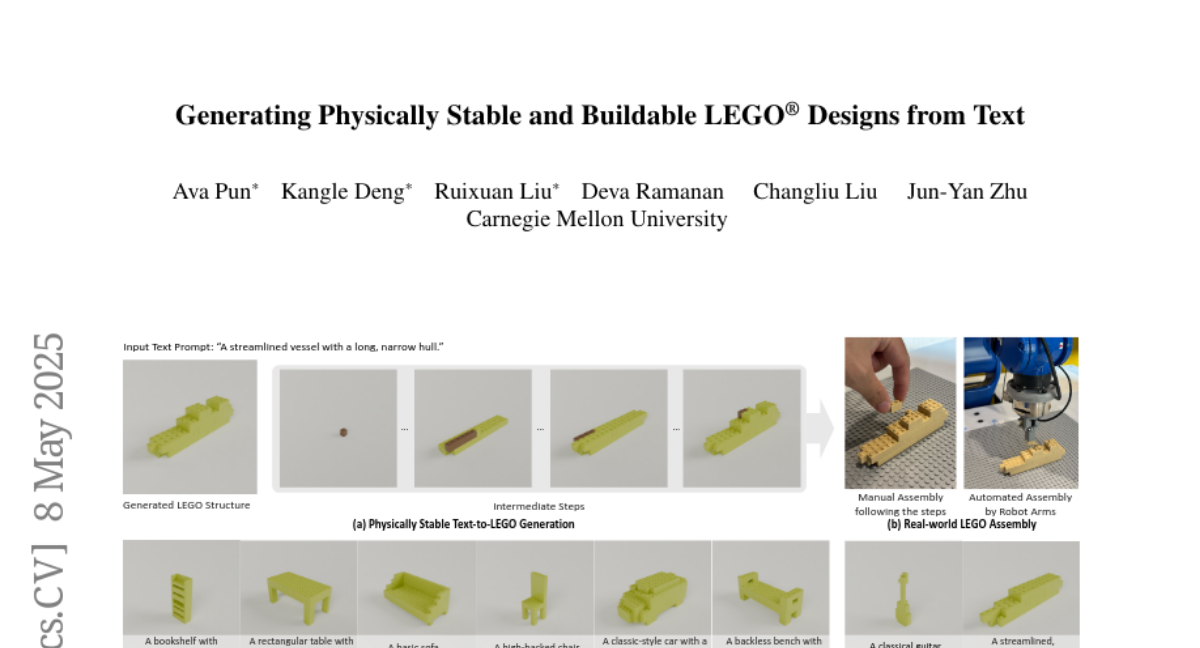
This paper talks about LegoGPT, a system that can take a written description and automatically create LEGO designs that are not only creative but also stable and possible to build in real life.
What's the problem?
The problem is that while it's fun to imagine cool LEGO creations, it's actually pretty hard for a computer to turn a text idea into a design that won't fall apart or be impossible to build. Most AI models don't think about the physical rules that real LEGO bricks need to follow.
What's the solution?
The researchers built LegoGPT, which uses a large language model that understands both what people want to build and the physics behind LEGO structures. It checks that the designs will actually stand up and can be put together, and it works for both people who want to build by hand and for automated assembly.
Why it matters?
This matters because it opens up new ways for people to be creative with LEGO, making it easier for anyone to turn their ideas into real, buildable models. It also shows how AI can help bridge imagination and real-world engineering, which could be useful in lots of other design fields too.
Abstract
LegoGPT generates physically stable LEGO models from text prompts using a large language model with physics-aware constraints and supports manual and automated assembly.