GenStereo: Towards Open-World Generation of Stereo Images and Unsupervised Matching
Feng Qiao, Zhexiao Xiong, Eric Xing, Nathan Jacobs
2025-03-18
Summary
This is a collection of research paper titles related to recent advances and challenges in AI, spanning areas like image and video generation, language models, robotics, and more.
What's the problem?
The problems addressed include improving the efficiency and quality of AI-generated content, enhancing the reasoning abilities of AI models, mitigating biases and safety risks, and enabling AI to better interact with the real world.
What's the solution?
The solutions involve developing new models, training techniques, benchmarks, and evaluation methods. These include innovations in diffusion models, transformers, reinforcement learning, and multimodal learning. Specific solutions focus on improving image compression (PerCoV2), generating consistent videos (CINEMA, Long Context Tuning), enabling robots to navigate and manipulate objects (UniGoal, adversarial data collection), and mitigating toxicity in online discussions (Silent Is Not Actually Silent).
Why it matters?
These advancements are important because they push the boundaries of AI capabilities, making AI more powerful, reliable, and beneficial for various applications. They also address critical challenges related to safety, fairness, and transparency, ensuring that AI is developed and deployed responsibly.
Abstract
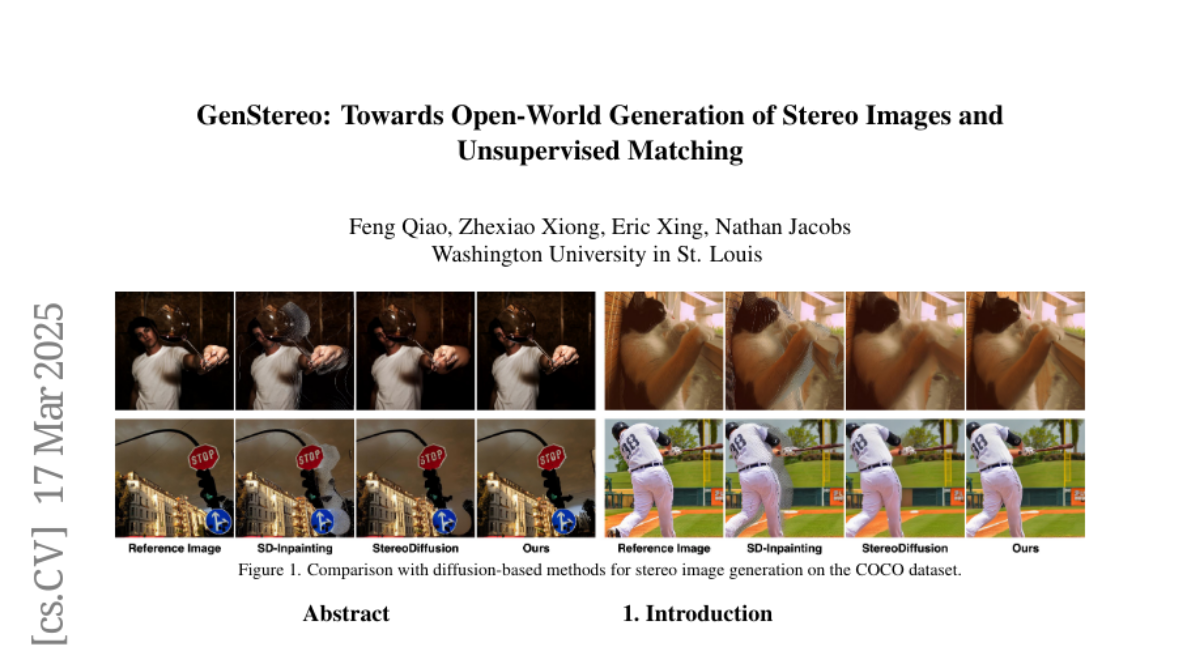
Stereo images are fundamental to numerous applications, including extended reality (XR) devices, autonomous driving, and robotics. Unfortunately, acquiring high-quality stereo images remains challenging due to the precise calibration requirements of dual-camera setups and the complexity of obtaining accurate, dense disparity maps. Existing stereo image generation methods typically focus on either visual quality for viewing or geometric accuracy for matching, but not both. We introduce GenStereo, a diffusion-based approach, to bridge this gap. The method includes two primary innovations (1) conditioning the diffusion process on a disparity-aware coordinate embedding and a warped input image, allowing for more precise stereo alignment than previous methods, and (2) an adaptive fusion mechanism that intelligently combines the diffusion-generated image with a warped image, improving both realism and disparity consistency. Through extensive training on 11 diverse stereo datasets, GenStereo demonstrates strong generalization ability. GenStereo achieves state-of-the-art performance in both stereo image generation and unsupervised stereo matching tasks. Our framework eliminates the need for complex hardware setups while enabling high-quality stereo image generation, making it valuable for both real-world applications and unsupervised learning scenarios. Project page is available at https://qjizhi.github.io/genstereo