GHOST 2.0: generative high-fidelity one shot transfer of heads
Alexander Groshev, Anastasiia Iashchenko, Pavel Paramonov, Denis Dimitrov, Andrey Kuznetsov
2025-02-27
Summary
This paper talks about a new way to teach AI language models words more efficiently, called vocabulary curriculum learning, which mimics how humans learn language
What's the problem?
Current AI language models learn all their words at once before they start training, which is different from how people learn language. This fixed approach makes it harder for AI to understand language at different levels and might not be the most efficient way to learn
What's the solution?
The researchers created a method that teaches AI new words gradually as it learns, just like how people learn language. Their approach uses something called entropy to decide when to add new words, and it helps the AI focus on harder words when needed. They tested this method on small AI models and found that it worked better than the old way of teaching all words at once
Why it matters?
This matters because it could make AI language models learn faster and better, which means we could create smarter AI assistants more quickly and with less computing power. It also helps AI understand language more like humans do, which could lead to AI that's better at communicating with people in natural ways
Abstract
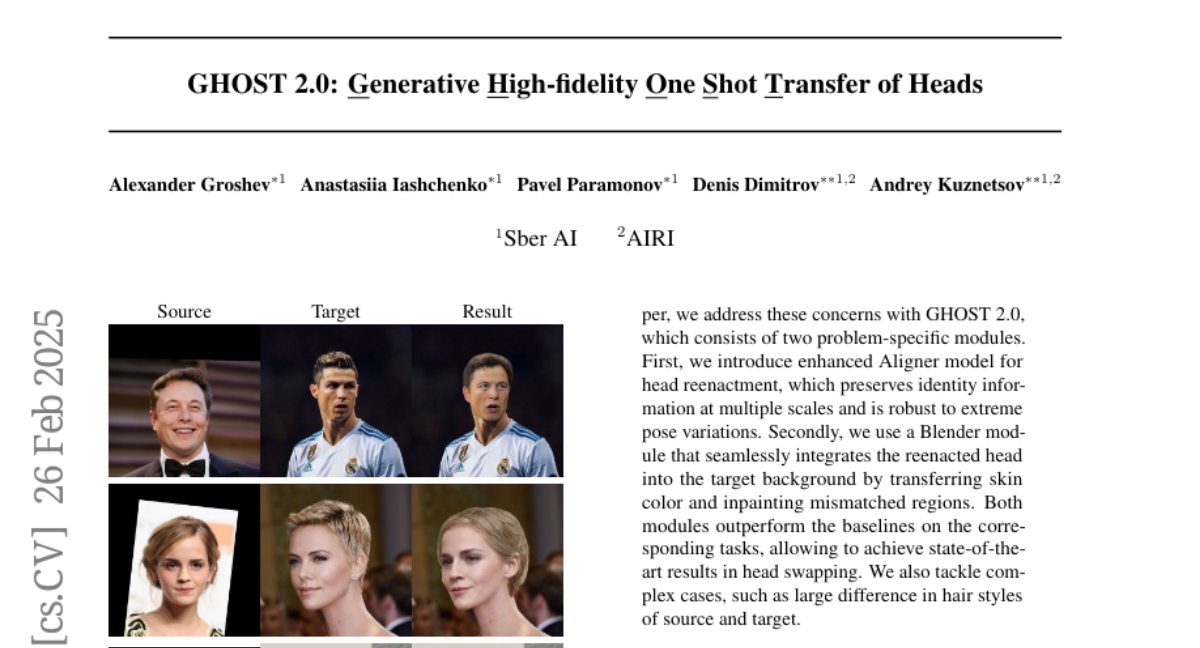
While the task of face swapping has recently gained attention in the research community, a related problem of head swapping remains largely unexplored. In addition to skin color transfer, head swap poses extra challenges, such as the need to preserve structural information of the whole head during synthesis and inpaint gaps between swapped head and background. In this paper, we address these concerns with GHOST 2.0, which consists of two problem-specific modules. First, we introduce enhanced Aligner model for head reenactment, which preserves identity information at multiple scales and is robust to extreme pose variations. Secondly, we use a Blender module that seamlessly integrates the reenacted head into the target background by transferring skin color and inpainting mismatched regions. Both modules outperform the baselines on the corresponding tasks, allowing to achieve state of the art results in head swapping. We also tackle complex cases, such as large difference in hair styles of source and target. Code is available at https://github.com/ai-forever/ghost-2.0