GLiNER multi-task: Generalist Lightweight Model for Various Information Extraction Tasks
Ihor Stepanov, Mykhailo Shtopko
2024-06-21
Summary
This paper introduces the GLiNER multi-task model, a lightweight machine learning model designed to efficiently extract information from text across various tasks, such as identifying names and answering questions.
What's the problem?
Information extraction tasks, like finding specific details in text, require models that are not only accurate but also efficient and adaptable. Traditional deep learning methods often need large amounts of data to perform well but struggle to adjust to different tasks. On the other hand, large language models (LLMs) can handle many tasks but are expensive to run and often produce outputs that aren't well-structured, making them less practical for everyday use.
What's the solution?
The researchers developed the GLiNER multi-task model, which is smaller and more efficient than traditional models while still being capable of handling various information extraction tasks. This model has shown state-of-the-art performance in zero-shot named entity recognition (NER), meaning it can identify names without needing specific training on those names first. It also performs well in tasks like question-answering and summarization. The paper discusses how the model uses self-learning techniques to improve its ability to recognize entities in text.
Why it matters?
This research is important because it addresses the need for more flexible and efficient tools for extracting information from text. By creating a model that can perform multiple tasks without requiring extensive resources, it can help organizations and applications that need to process large amounts of information quickly and accurately. This advancement could lead to better AI systems in areas like customer service, data analysis, and content creation.
Abstract
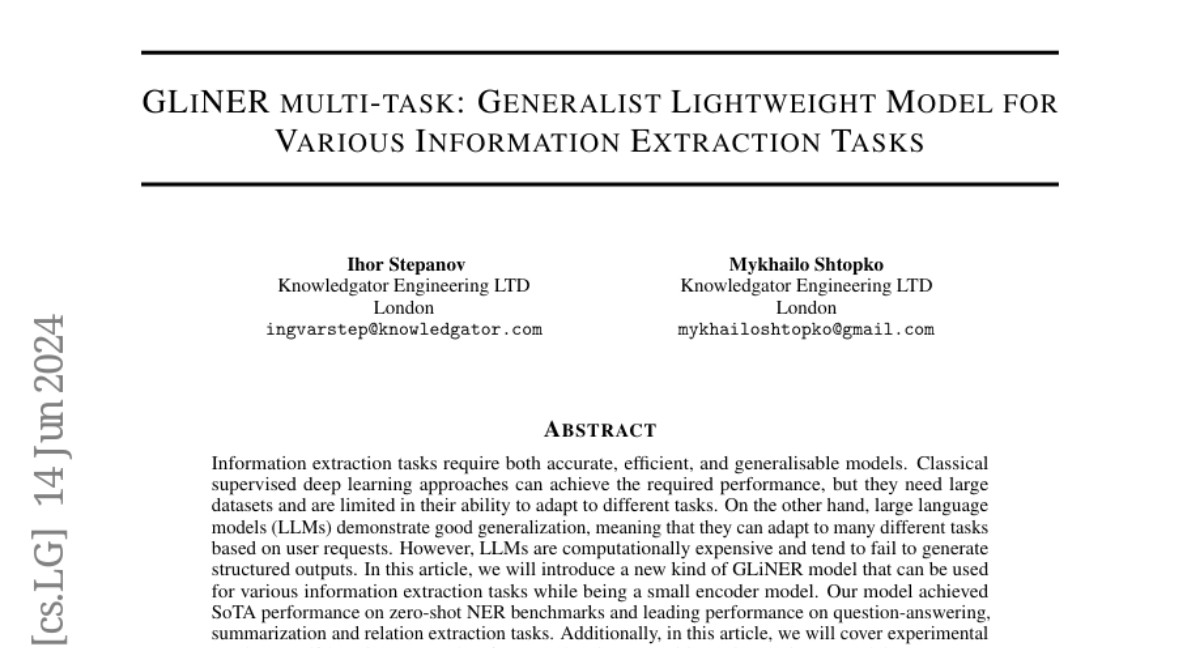
Information extraction tasks require both accurate, efficient, and generalisable models. Classical supervised deep learning approaches can achieve the required performance, but they need large datasets and are limited in their ability to adapt to different tasks. On the other hand, large language models (LLMs) demonstrate good generalization, meaning that they can adapt to many different tasks based on user requests. However, LLMs are computationally expensive and tend to fail to generate structured outputs. In this article, we will introduce a new kind of GLiNER model that can be used for various information extraction tasks while being a small encoder model. Our model achieved SoTA performance on zero-shot NER benchmarks and leading performance on question-answering, summarization and relation extraction tasks. Additionally, in this article, we will cover experimental results on self-learning approaches for named entity recognition using GLiNER models.