GoalFlow: Goal-Driven Flow Matching for Multimodal Trajectories Generation in End-to-End Autonomous Driving
Zebin Xing, Xingyu Zhang, Yang Hu, Bo Jiang, Tong He, Qian Zhang, Xiaoxiao Long, Wei Yin
2025-03-17
Summary
This paper introduces GoalFlow, a new method for self-driving cars to generate safe and realistic driving paths.
What's the problem?
Self-driving cars need to plan their routes, but it's tricky because there are often multiple good options, and current AI models struggle to create diverse paths that are both high-quality and consistent with the environment.
What's the solution?
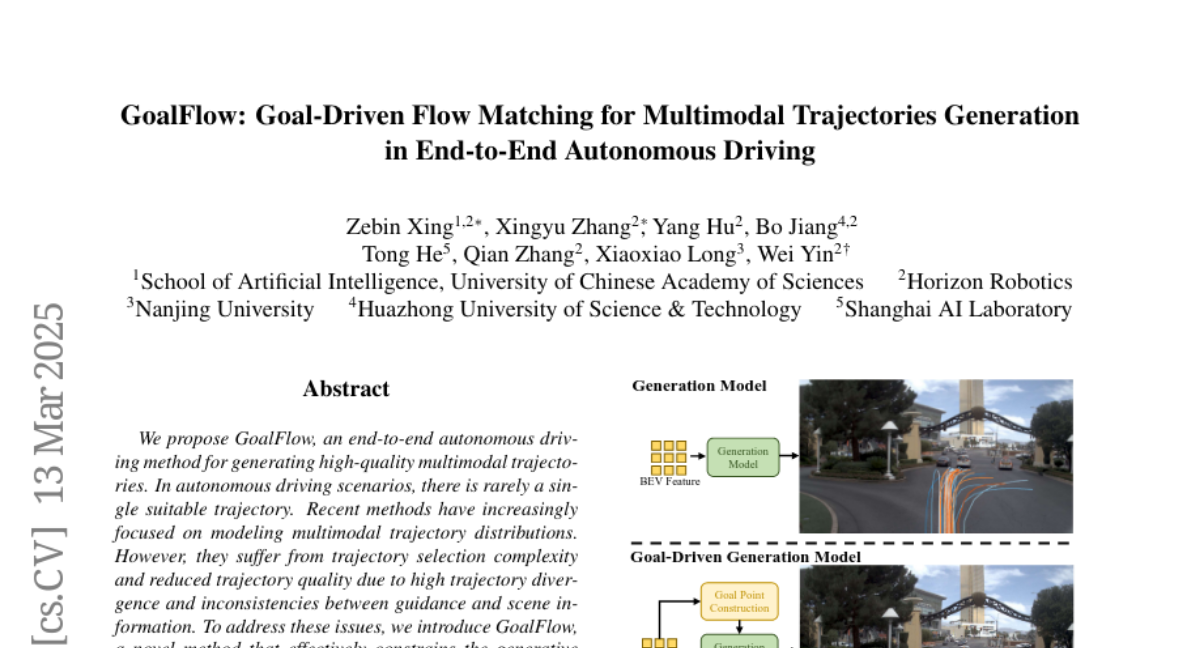
GoalFlow guides the AI to generate paths that reach specific goal points and uses a scoring system to choose the best goal point based on the surrounding environment. It also uses an efficient method called Flow Matching to create various driving paths, and then selects the best one using another scoring system.
Why it matters?
This work matters because it helps self-driving cars make better decisions and navigate more safely by generating a range of high-quality paths that are appropriate for different driving situations.
Abstract
We propose GoalFlow, an end-to-end autonomous driving method for generating high-quality multimodal trajectories. In autonomous driving scenarios, there is rarely a single suitable trajectory. Recent methods have increasingly focused on modeling multimodal trajectory distributions. However, they suffer from trajectory selection complexity and reduced trajectory quality due to high trajectory divergence and inconsistencies between guidance and scene information. To address these issues, we introduce GoalFlow, a novel method that effectively constrains the generative process to produce high-quality, multimodal trajectories. To resolve the trajectory divergence problem inherent in diffusion-based methods, GoalFlow constrains the generated trajectories by introducing a goal point. GoalFlow establishes a novel scoring mechanism that selects the most appropriate goal point from the candidate points based on scene information. Furthermore, GoalFlow employs an efficient generative method, Flow Matching, to generate multimodal trajectories, and incorporates a refined scoring mechanism to select the optimal trajectory from the candidates. Our experimental results, validated on the NavsimDauner2024_navsim, demonstrate that GoalFlow achieves state-of-the-art performance, delivering robust multimodal trajectories for autonomous driving. GoalFlow achieved PDMS of 90.3, significantly surpassing other methods. Compared with other diffusion-policy-based methods, our approach requires only a single denoising step to obtain excellent performance. The code is available at https://github.com/YvanYin/GoalFlow.