GTR: Guided Thought Reinforcement Prevents Thought Collapse in RL-based VLM Agent Training
Tong Wei, Yijun Yang, Junliang Xing, Yuanchun Shi, Zongqing Lu, Deheng Ye
2025-03-13
Summary
This paper talks about GTR, a method that helps AI systems think clearly and avoid getting stuck when solving visual puzzles or real-world tasks using trial and error.
What's the problem?
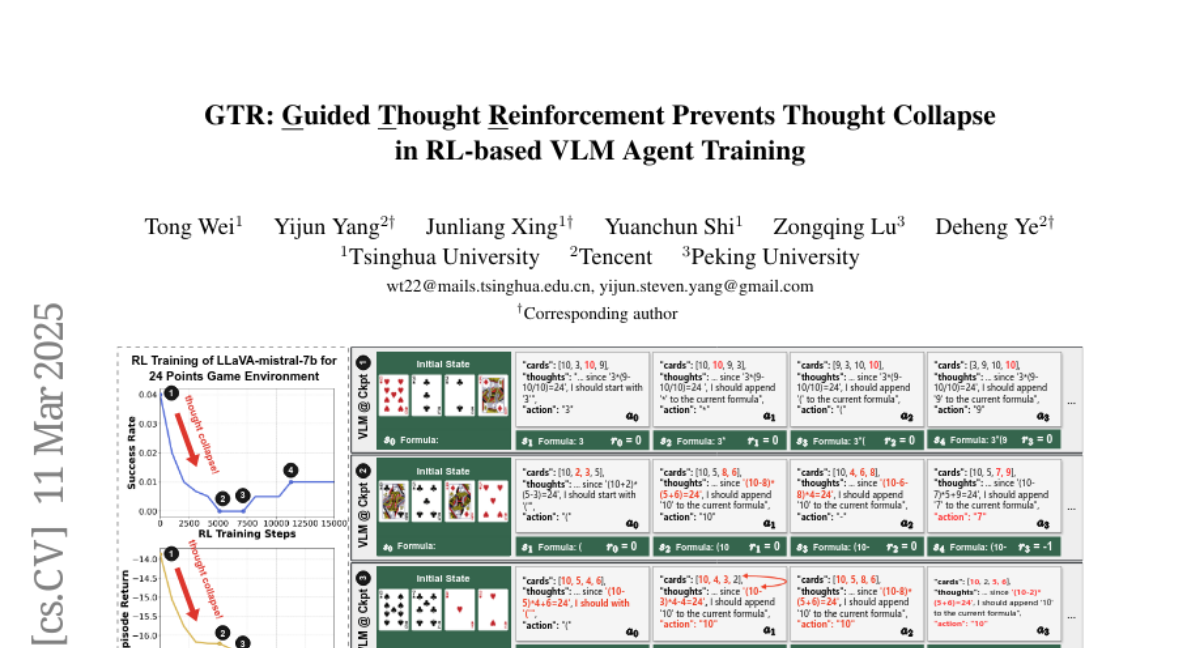
When AI models learn by trial and error with only final results as feedback, they stop explaining their reasoning steps and make random guesses, leading to mistakes.
What's the solution?
GTR adds an automated checker that reviews the AI’s thought process during training, guiding it to keep reasoning steps clear and relevant to the task.
Why it matters?
This improves AI reliability in tasks like game-solving or robot navigation, where clear thinking matters, and reduces errors in critical applications like healthcare or customer service.
Abstract
Reinforcement learning with verifiable outcome rewards (RLVR) has effectively scaled up chain-of-thought (CoT) reasoning in large language models (LLMs). Yet, its efficacy in training vision-language model (VLM) agents for goal-directed action reasoning in visual environments is less established. This work investigates this problem through extensive experiments on complex card games, such as 24 points, and embodied tasks from ALFWorld. We find that when rewards are based solely on action outcomes, RL fails to incentivize CoT reasoning in VLMs, instead leading to a phenomenon we termed thought collapse, characterized by a rapid loss of diversity in the agent's thoughts, state-irrelevant and incomplete reasoning, and subsequent invalid actions, resulting in negative rewards. To counteract thought collapse, we highlight the necessity of process guidance and propose an automated corrector that evaluates and refines the agent's reasoning at each RL step. This simple and scalable GTR (Guided Thought Reinforcement) framework trains reasoning and action simultaneously without the need for dense, per-step human labeling. Our experiments demonstrate that GTR significantly enhances the performance and generalization of the LLaVA-7b model across various visual environments, achieving 3-5 times higher task success rates compared to SoTA models with notably smaller model sizes.