Harnessing Vision Models for Time Series Analysis: A Survey
Jingchao Ni, Ziming Zhao, ChengAo Shen, Hanghang Tong, Dongjin Song, Wei Cheng, Dongsheng Luo, Haifeng Chen
2025-02-19
Summary
This paper talks about using vision models, which are typically used for image analysis, to analyze time series data. It's like teaching a computer that's good at looking at pictures to understand patterns in things that change over time, such as stock prices or weather patterns.
What's the problem?
Current methods for analyzing time series data, especially those using language models, have some limitations. They struggle with the continuous nature of time series data and have trouble understanding how different variables in the data relate to each other. It's like trying to describe a flowing river using only individual words - it's not quite capturing the whole picture.
What's the solution?
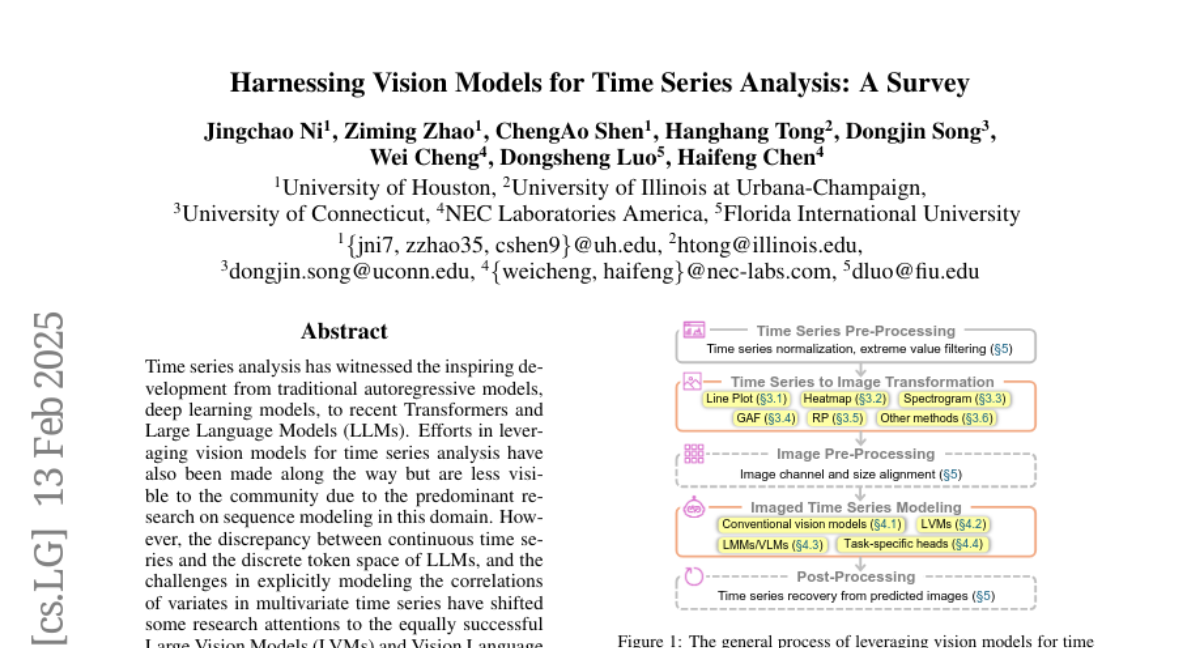
The researchers surveyed different ways to turn time series data into images that vision models can understand. They looked at methods for converting the data into visual formats like line plots, heatmaps, and spectrograms. Then, they explored how to use vision models to analyze these images for various tasks. It's like taking a graph of temperature changes over time and turning it into a picture that a computer can 'see' and understand.
Why it matters?
This matters because it could lead to better ways of predicting trends, detecting anomalies, and understanding complex patterns in time series data. By using vision models, we might be able to spot patterns that other methods miss, which could be really helpful in fields like finance, weather forecasting, or monitoring health data. It's opening up a new toolbox for scientists and analysts to work with time-based information more effectively.
Abstract
Time series analysis has witnessed the inspiring development from traditional autoregressive models, deep learning models, to recent Transformers and Large Language Models (LLMs). Efforts in leveraging vision models for time series analysis have also been made along the way but are less visible to the community due to the predominant research on sequence modeling in this domain. However, the discrepancy between continuous time series and the discrete token space of LLMs, and the challenges in explicitly modeling the correlations of variates in multivariate time series have shifted some research attentions to the equally successful Large Vision Models (LVMs) and Vision Language Models (VLMs). To fill the blank in the existing literature, this survey discusses the advantages of vision models over LLMs in time series analysis. It provides a comprehensive and in-depth overview of the existing methods, with dual views of detailed taxonomy that answer the key research questions including how to encode time series as images and how to model the imaged time series for various tasks. Additionally, we address the challenges in the pre- and post-processing steps involved in this framework and outline future directions to further advance time series analysis with vision models.