How Instruction and Reasoning Data shape Post-Training: Data Quality through the Lens of Layer-wise Gradients
Ming Li, Yanhong Li, Ziyue Li, Tianyi Zhou
2025-04-16
Summary
This paper talks about how the quality of the instructions and reasoning examples used to finish training large language models can affect how well these models learn, and it explores this by looking closely at the math behind the training process.
What's the problem?
The problem is that not all training data is equally helpful for teaching AI models, especially when it comes to complex reasoning or following instructions. If the data isn't good enough, the models might not learn as effectively, which can limit their abilities in real-world tasks.
What's the solution?
The researchers used a detailed mathematical approach called spectral analysis to study the changes, or gradients, in the model's layers during training. By using special metrics like nuclear norms and effective ranks, they were able to measure how different types of data affect the model's learning. This helped them figure out which kinds of data are actually making the model smarter and which are not as useful.
Why it matters?
This matters because understanding how data quality impacts training can help scientists and engineers choose or create better data for teaching AI. This leads to smarter, more reliable models that perform better on tasks that require clear instructions and good reasoning, which benefits everyone who uses AI in school, work, or daily life.
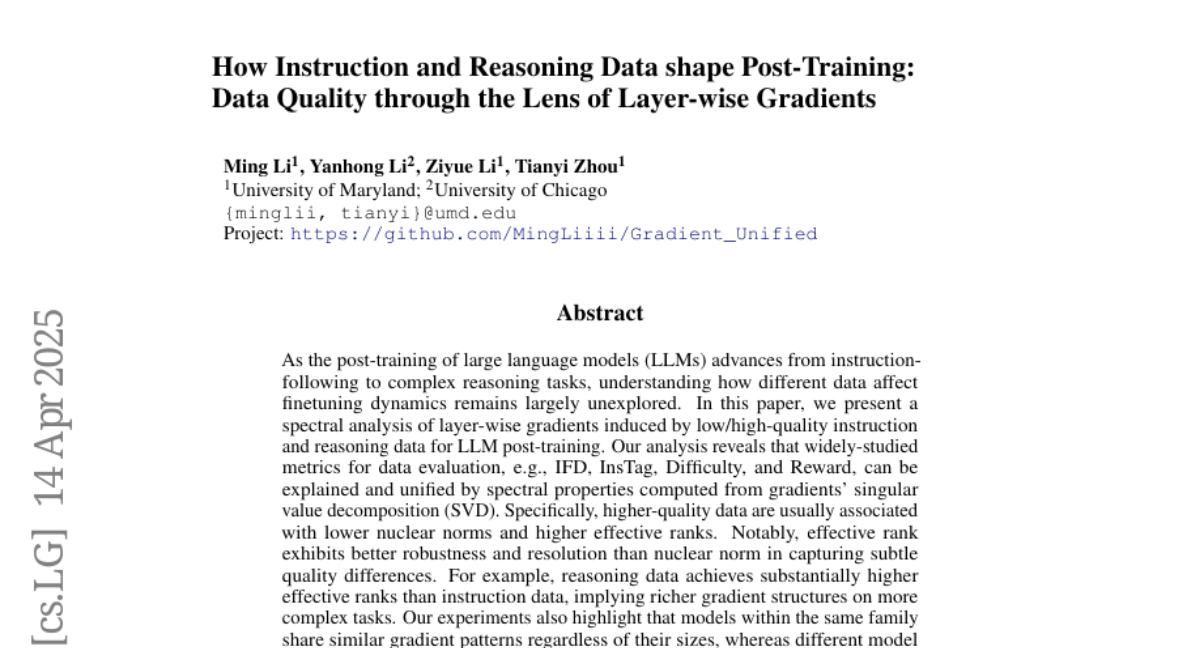
Abstract
A spectral analysis of gradients during the post-training of large language models reveals the impact of data quality using metrics like nuclear norms and effective ranks, providing insights into improving data exploration strategies.